



 I want to donate
Identity Politics
- Book Extracts
- 3 Oct 2020
-
184views

Into the vacuum of meaning left by a rejection of meta-narrative and a suspicion of all language as power play, other ideas that locate meaning primarily in ourselves have begun to take root. In The Madness of Crowds, Douglas Murray observes, ‘People in wealthy Western democracies today could not simply remain the first people in recorded history to have absolutely no explanation for what we are doing here, and no story to give life purpose.’ Rather than continue in a self-contradictory embracing of the non-possibility of meaning (postmodernism), Western society has evolved and settled on a new ideology to give society meaning – this movement is one that prizes the experience of those on the receiving end of injustice; it defines humanity religiously along these lines.
Discussions around identity, safe spaces and self-realization are fruits of this fundamental shift in culture. Sociologically, this is often called ‘identity politics’, which is undergirded by what is known as ‘intersectionality’. This means interpreting the world through the lens of multiple layers of social injustice that intersect for a given individual or group in different ways. I may be white (privileged), but I am female (I have a claim to experience injustice) and I am the daughter of a refugee (my family has experienced racism). If I were disabled or queer or a person of colour, I would experience further layers of intersectional injustice within this way of seeing the world. The markers of my experience of intersectional social injustice become the foundation of my personal identity and the identity of any group of which I am a part, so these markers determine my right to speak and interpret the world.
‘Identity’ reigns over everything – my interpretation of texts and the way I see the world; so the more layers of intersectionality I can lay claim to, the more authoritative my interpretation of texts and events. This approach places the individual or group ‘identity’ above all other distinguishing factors about a person and, where injustice has been experienced, the goal is to rebalance society by bringing a corrective emphasis. At a popular level, any person or opinion that challenges the ideas of a person or group with claims to intersectional superiority is a ‘hater’. This is now the primary lens through which to interpret meaning – whether in relationships, dialogues, media reports or texts.
This way of seeing the world is the fruit of the postmodern fascination with the dynamics of power. Power determines meaning. As a result, there can now be no distinction between disagreeing with an idea and ‘cancelling’ or ‘deleting’ the person who identifies so completely with that idea. So anyone who dares to express a different perspective or interpretation is a proponent of hatred. Thoughts and views are weaponized, language is far more aggressive than it used to be and people may be reported to the police or to their employers for simple statements of ideas on Twitter. Increasingly, it is not even enough to remain silent. The thoughts in people’s heads in all of society must be policed and must be brought to conform with ‘identity’ thinking.
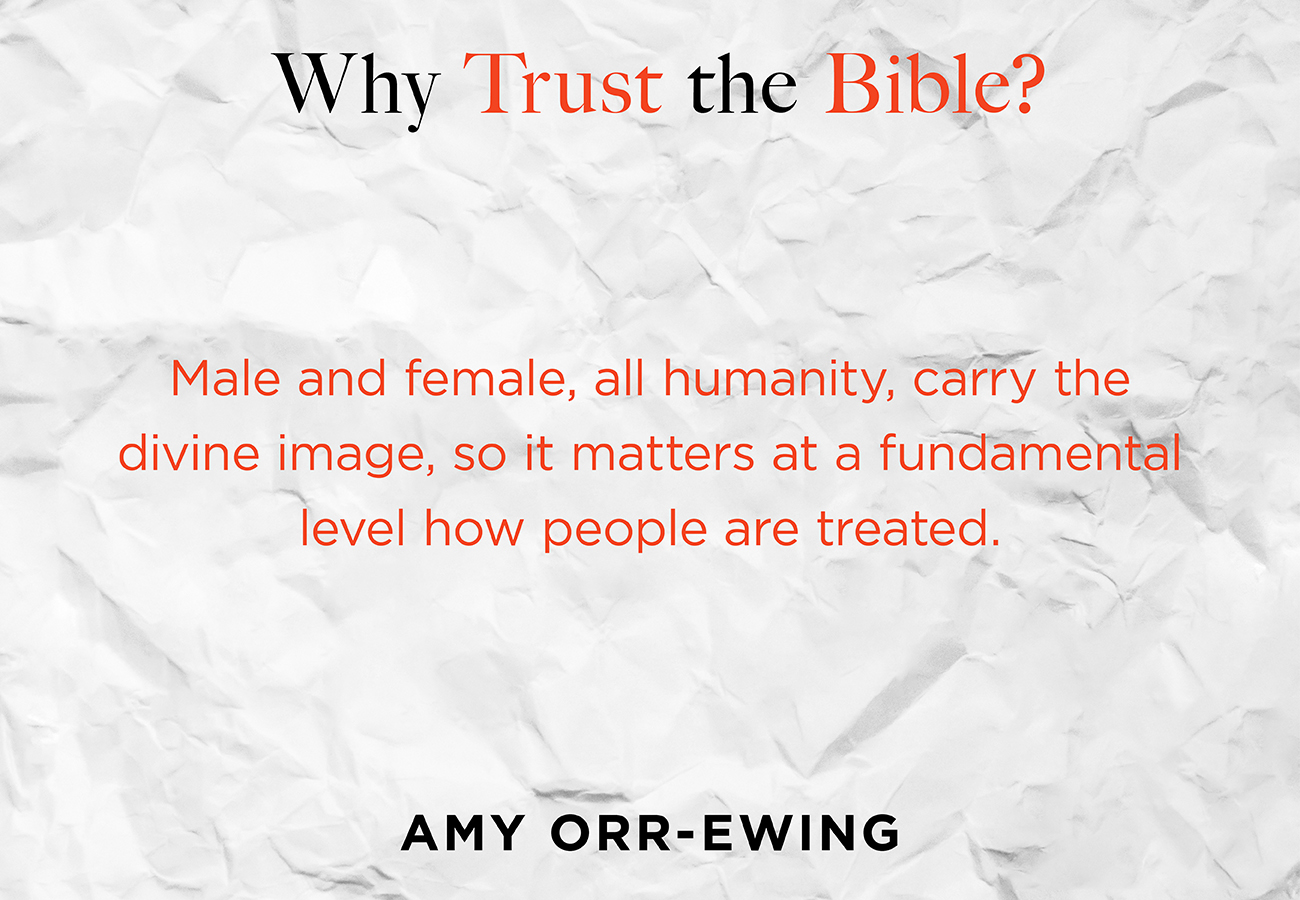
The instincts that people are precious and deserving of dignity and that injustice is wrong are correct instincts – in fact they are strongly supported by the Bible. If human beings are created in the image of God, as Genesis 1:27 suggests, then we have an explanation in Scripture for the essential validity of humanity. But the wrongs that intersectional thinking is trying to right won’t be resolved by an ever-increasing anger and violence towards people who see the world differently from us. Might it be possible that there is a loving authority beyond us who has created us, who has made himself known to us, including his thoughts on injustice and the value of people? Might it be possible that, by reading an ancient text, wisdom for today actually exists?
Sometimes people ask me, ‘You don’t honestly believe the Bible literally, do you?’ This question has become increasingly important because people are frightened of any kind of religious fundamentalism in the world around us. Following 9/11 and the emergence of Islamic State, many of us fear that if people begin to believe what their holy books say, it is a very dangerous thing. To take a religious book literally is perceived as one of the most stupid and misguided things we can do. Of course, it is important to remember that it is not the act of believing what a book says or taking it literally that is necessarily dangerous. The danger is determined by the content of the book.
What will we find when we read?
Does the book incite violence?
Does it lend itself to a dangerous use?
It cannot be an inherently wrong thing to accept what written words are saying. We do that all the time – the danger depends on the message. So how do we answer the question ‘Should we take the Bible literally?’
If the Bible says that Herod is a fox, does that mean he has a bushy tail and pointy ears?
It also says that Jesus is the door; is that intended to mean that he is wooden, flat and swinging on hinges?
No. Clearly, metaphors are in play. To assert that it is possible for a text to have meaning, and to communicate that meaning to a reader or listener, is not to take away entirely the responsibility of the reader or listener to participate in the process. Readers must ask questions about the author’s intentions, as well as scrutinize their own motivations and reactions. The historical context of the text plays a part, as does the cultural context of the reader. I think that to assert dogmatically that it is impossible for any text to have and communicate meaning is to be closed-minded. Equally, I believe that a refusal to engage with a truth claim on the basis that it challenges some aspect of identity-political group-thinking is short-sighted. The ideals and shibboleths of identity politics will move on and change with time, so why not engage with a text that billions of people have found to be both life-changing and life-giving? The Christian faith does not ask a sceptical person to do this by naively accepting what is in the Bible ‘because we say so’, but only to be openminded enough to read a Gospel and ask questions of it, to scrutinize it and see for ourselves whether or not what we find is compelling, meaningful and truthful.
If this extract has piqued your interest, why not continue investigating whether trusting the Bible is just a matter of picking and choosing what and who to believe? Amy's Why Trust the Bible? can be ordered now, and is one of the IVP October 2020 Releases. Below you'll find some other books that might help you think through questions of meaning and the Bible's trustworthiness.
Related Posts
Categories
Recent Posts
3

IVP Authors at Keswick Convention 2026
18 Jul 2026
Support IVP with your donation
Either donate with a one-off donation or subscribe monthly.
Choose a type of donation
I want to donate
 I want to donate