



 I want to donate
W. H. Griffith Thomas: British Evangelical Theologian of the Twentieth Century
- Tom Creedy
- In Remembrance
- 2 Jun 2022
-
386views

In the entry on W. H. Griffith Thomas in The New Dictionary of Theology: Historical and Systematic, P. H. Friesen writes:
Anglican theologian, writer and international conference speaker, Thomas served the evangelical world in Britain, Canada and the United States amidst the crises of the early twentieth century. William Henry Griffith Thomas was born in Oswestry, Shropshire, England. As his father died before Thomas’s own birth (2 January 1861), and the death of his grandfather (who was his guardian) was attended by litigation, Thomas was obliged to leave school at fourteen years old. Already an involved layman in his Anglican parish, he had a definitive evangelical conversion in 1878, an experience he never forgot. About eighteen months later he had an experience of sanctification that quickly brought him into contact with Keswick holiness teaching. His spiritual passion continued to grow after he went up to London to work in the office of a relative. He proved to be a bright student, keen to study biblical Greek into the night. Thomas soon came to the attention of the local vicar, who offered him a lay curacy in his parish, a paid position. This allowed him to leave his job, to assist the vicar and to enrol in the three-year divinity programme at King’s College, where he excelled and gained the patronage of the principal, Henry Wace.
Thomas was ordained deacon in 1885 but declined any new appointment until 1889. As a senior curate now, under A. M. W. Christopher at the evangelical parish of St Aldate’s, Oxford, Thomas’s academic abilities became obvious to the wider ecclesiastical world. He began theological studies at Christ Church and earned his BD at the age of thirty-four. In 1896 Thomas accepted an invitation to serve the proprietary chapel at Portman Square, London and started advanced theological study. The next few years were happy. Thomas was married (1898) and soon became a father; the chapel succeeded and was regularized as the parish of St Paul (1902); he completed most of the work on his doctoral dissertation; and he came to national and international attention through his preaching and lecturing. He also completed his popular evangelical exposition of theology and the Christian life, The Catholic Faith: A Manual of Instruction for Members of the Church of England, the first of many well-known books.
Thomas’s academic career commenced with his appointment as principal of the evangelical Anglican Wycliffe Hall, Oxford (1905), and the DD granted to him by Oxford for his dissertation on the Holy Spirit, published immediately as A Sacrament of our Redemption. At Wycliffe Hall he did much of the lecturing and formation of students for ordination. His writing, his interdenominational speaking in North America and the growing testimony of evangelical Anglicans in England to his abilities led to several career opportunities.
In 1910, weary from his administrative load and eager to take up more lecturing and writing opportunities, Thomas accepted the offer of Wycliffe College, Toronto, another evangelical Anglican seminary, of a post as professor of theology. His nine years there made him widely known in North America. In 1913 he delivered the Stone Lectures at Princeton, published as The Holy Spirit of God. But his professional relationship with the administration and council of Wycliffe College grew increasingly tense, and led to one of the most surprising dismissals in evangelical history. A ten-point ‘Special Report’ prepared by the executive committee charged Thomas with not making the interests of the college his priority. In his response of early 1919 Thomas gave voice to his sense of hurt and betrayal. He argued that he had done everything to which he had agreed and more, though his original salary and housing arrangements had not been honoured. Nor had he for some years after he arrived been allowed to teach theology courses reserved for H. J. Cody (rector of St Paul’s, Bloor Street, since 1907 and defeated candidate in the diocese of Toronto episcopal elections of 1909). Thomas felt he had tried but failed to prove himself enough of a Canadian Anglican to satisfy his critics. So, he argued, he accepted invitations to speak or lecture on theology (regardless of denomination or nation), rather than the invitations of major donors in the Wycliffe circle, who expected him to engage in Anglican politics. Thomas was unwilling to be enlisted in the battles between evangelicals and Anglo-Catholics during the revision of the Canadian Prayer Book. After a last attempt at compromise by both sides, Thomas’s resignation was demanded, offered and received before the end of the spring 1919 term.
Thomas’s reputation was not damaged, in spite of stories about his departure in Canada’s largest dailies. A nervous ad hoc publicity committee consisting of H. J. Cody, Dyson Hague and others prepared Wycliffe for a possible public backlash, though decorum in the end prevailed. Thomas remained popular in Canada, where he had travelled widely as a Wycliffe professor, and Wycliffe luminaries continued to praise his Anglican publications. But Thomas quickly moved to Philadelphia to take up a variety of writing and speaking responsibilities, including the editing of The Sunday School Times and leadership of the American, sanctification-oriented Victorious Life conferences, both of which he had long supported. It was there that he helped to plan with Lewis Sperry Chafer and others the projected Evangelical Theological College, later Dallas Theological Seminary. In the midst of many engagements that took him from China and Japan in 1920 to King’s College, Halifax, in the spring of 1924, his body failed. He died suddenly in Philadelphia on 2 June 1924. His posthumous The Principles of Theology: An Introduction to the Thirty-Nine Articles (London: Church Book Room Press, 1930) proved highly popular and remained in print for decades.
Thomas can be best described as a moderate Anglican evangelical who consciously held to the Reformation tradition. He was a responsible and widely read scholar who chose to give his life less to original research than to theology in the service of the international church. Yet he was never Calvinist enough for Benjamin Warfield or Pentecostal enough for zealots within the Victorious Life movement or dispensationalist enough for Charles Scofield and others with whom he agreed to cooperate. Not polemical but surprisingly irenic by nature, he saved his harder words for the extremes of Anglo-Catholic theology, and in later life for aggressive modernism. Even then he generally avoided politics, and as the fundamentalist-modernist controversy broke out in America he consistently refused to utter the shibboleths (which he blamed on ‘puritanism’) about historical criticism or biblical inerrancy or matters of science that were essentials for many with whom he worked. Nor did he agree to stop quoting James Orr or P. T. Forsyth, moderate conservatives with whom he had a deep sympathy but who did not fit the agenda of many around him. Christ as revealed in the Bible was supremely authoritative for him. But Christianity was above all ‘spiritual’. He quarrelled with tight intellectual systems (for which he blamed ‘rationalism’), as they elevated the fatal limitations of human logic above the limitless power of the Holy Spirit to lead Christians into the spiritual experience of divine truth.
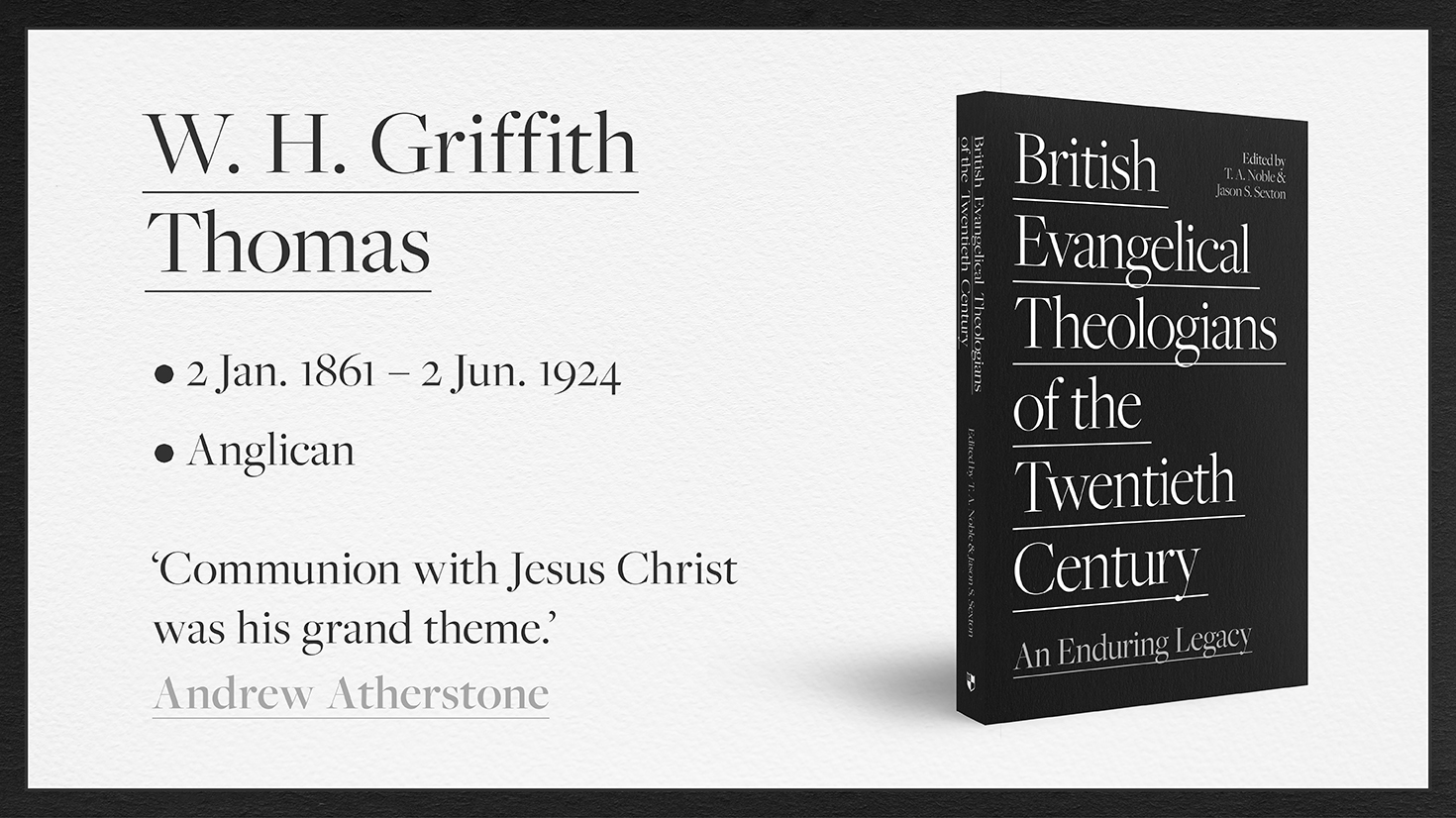
As one of the British Evangelical Theologians from the earlier part of the Twentieth Century, Thomas's influence is well worth reflecting on. Andrew Atherstone's chapter in British Evangelical Theologians of the Twentieth Century, edited by T. A. Noble and Jason S. Sexton, is a good place to start. You can order your copy in paperback or ebook now.
Related Posts
Categories
Recent Posts
3

IVP Authors at Keswick Convention 2026
18 Jul 2026
Support IVP with your donation
Either donate with a one-off donation or subscribe monthly.
Choose a type of donation
I want to donate
 I want to donate