



 I want to donate
P. T. Forsyth: British Evangelical Theologian of the Twentieth Century
- Tom Creedy
- Blog
- 12 May 2022
-
342views
In the entry on P. T. Forsyth in The New Dictionary of Theology: Historical and Systematic, J. Gordon writes:
Forsyth was born and educated in Aberdeen in Scotland. On advice from his friend William Robertson Smith, he studied theology under Ritschl at Göttingen, then at New College, London, after which he spent the rest of his life as a pastor and theologian. Both words are required to explain the power and passion of Forsyth’s theological oeuvre. He was Congregational pastor for twenty-five years in Shipley (1876), Manchester (1885), Leicester (1888) and Cambridge (1894), followed by twenty years as Principal of Hackney College in London. In 1899 and 1907 he visited the United States, in 1905 was Chairman of the Congregational Union, and in 1910 was appointed Dean of the London Faculty of Theology.
During his early pastoral years his theological position moved from liberal theologian heavily indebted to German thought, and impatient with traditional formulations of doctrine, to that of ‘classical Christianity’ with an enduring focus on the cross as the ‘magnetic north’ on the Christian compass. The consequences of Forsyth’s theological and personal ‘conversion’ was an abandonment of earlier humanistic ideas, while retaining the tools of liberal higher criticism used now with discriminating purpose . In 1896 the potent mix of critical scholarship, personal tragedy on the death of his wife, and evangelical experience were distilled into an address entitled ‘The Holy Father’, in which Forsyth announced the main emphases of his future theological manifesto.
From 1897 when The Holy Father and the Living Christ was published, until 1918 when his last book This Life and the Next was issued, Forsyth produced a steady flow of constructive, pastoral, occasional and at times polemical theological publications. The range of interest and subjects indicates the non-systematic but contextually engaged style of Forsyth’s theology. He wrote important, original constructive treatments of the atonement and Christology; presented fresh construals of ecclesiology and the sacraments combined with bold statements on issues of church relations and polity; produced bracing and robust reflections on prayer and spirituality which while eschewing mystical speculation do not lack a sense of the profound, transformative power of encounter with God in Christ; and his lectures on preaching and art indicate the breadth and depth of Forsyth’s awareness of the pastoral realities and *cultural constraints that must inform and challenge contemporary articulation and proclamation of the gospel. There is no discernible overarching programme in Forsyth’s theological writing and development other than the pervasive, recurring attention he pays to the cross as the work of Christ.
Forsyth’s secure grasp and trenchant expression of both evangelical essentials and critical scholarship made him a key opponent of R. J. Campbell’s so-called New Theology, and a recognized theological leader within and beyond English Congregationalism. Gratefully confessing that he had been turned ‘from a love of God to an object of grace’, his emphases in some respects anticipated Barth. The objectivity and primacy of grace, the ‘Christological concentration’ on Jesus Christ crucified and risen as the centre of theology and revelation, and biblical exegesis as the primary basis and essential content of dogmatics, are emphases shared by the two theologians without traceable dependence.
Like his contemporary, James Denney, Forsyth presented the atonement as a reality beyond the conceptual control of one theory. Reconciliation, judgment, substitution, victory, regeneration, sacrifice and satisfaction provide a complex nexus of ideas that are woven together into a continuing exposition of the cross. However, in seeking an understanding of atonement adequate to its significance for Christian faith, the holy love of God became both the dogmatic background and kerygmatic foreground of Forsyth’s exposition (see especially The Cruciality of the Cross and The Work of Christ). Rejecting any sentimental or ‘soft’ view of divine love and Fatherhood, and dismissive of reductionist views of sin to psychological or social forces, he insisted on the ontological reality and radical moral and eternal consequences of sin.
The cruciality of the cross derives, for Forsyth, from the centrality of Christ as God’s self-revelation of holy love, the overcoming of sin by ‘a holy God, self-atoned in Christ [as] the centre of the world’. In his Christology (particularly The Person and Place of Jesus Christ), Forsyth explored a form of *kenosis which sought to do justice to divine immutability and the reality of God incarnate in Christ, primarily by asserting the crucial connection between incarnation and atonement, and by balancing divine kenosis with the notion of divine plerosis, ‘making dogmatic room for Christ’s growth in grace, personality and achievement until he was filled with the fullness of God’(McCurdy, Attributes and Atonement).
In Christian Perfection and The Soul of Prayer Forsyth expounded Christian spirituality as a matter of will directed to obedience, as inner moral urgency generated by grace finds expression in an outward and active engagement with the world. Rather than contemplative cultivation of spiritual experience, Forysth urged the energizing exertion of will, wrestling with God, because ‘resisting His will may be doing His will’, and ‘our soul is fulfilled if our petition is not’. Unanswered prayer is never a reason for thinking ill of
God: ‘He says no in the spirit of yes.’ Through prayer moral personality is renewed in the regular encounter of the soul with the God who is Holy Love. The cross gives prayer its guarantees and its moral power. Thus the Christian life is ‘repentant praise’, because ‘we confess much more than sin – a Saviour to our own worst depths and to the wide ends of the earth’.
In his thinking and writing, Forsyth ranged widely across cultural and theological fields. Almost a third of his library included German theologians, amongst them Ritschl, Kähler, Zahn and Schlatter. He expressed conscious indebtedness to the great Congregational Puritans, Owen and Goodwin, whose writings ‘not only tingle, they soar’, and live on in the spiritual life. From English theologians such as Maurice, Forsyth derived important insights on the nature of faith, and from Dale a permanent conviction of the centrality of Jesus in constructive theology of the atonement, and the cross as the primary focus of Christian theology. An early reader of the astringent Kierkegaard, appreciative of Pascal’s epigrammatic fire, suspicious of mysticism ‘used as the sufficient basis of religious certainty for a whole church’, he nevertheless insisted, ‘Bernard is my favourite saint and his Canticles a great delight.’ The poets were read with receptive admiration (Dora Greenwell, a favourite), with critical appreciation (Browning) or outright disagreement (Whittier). The mind of Forsyth was both free-ranging and theologically assimilative, but to the powerfully centred end of expounding the person and work of Christ in terms that, while never adequate, would at least seek ‘to stretch to the measure of eternal things without breaking under us somewhere’.
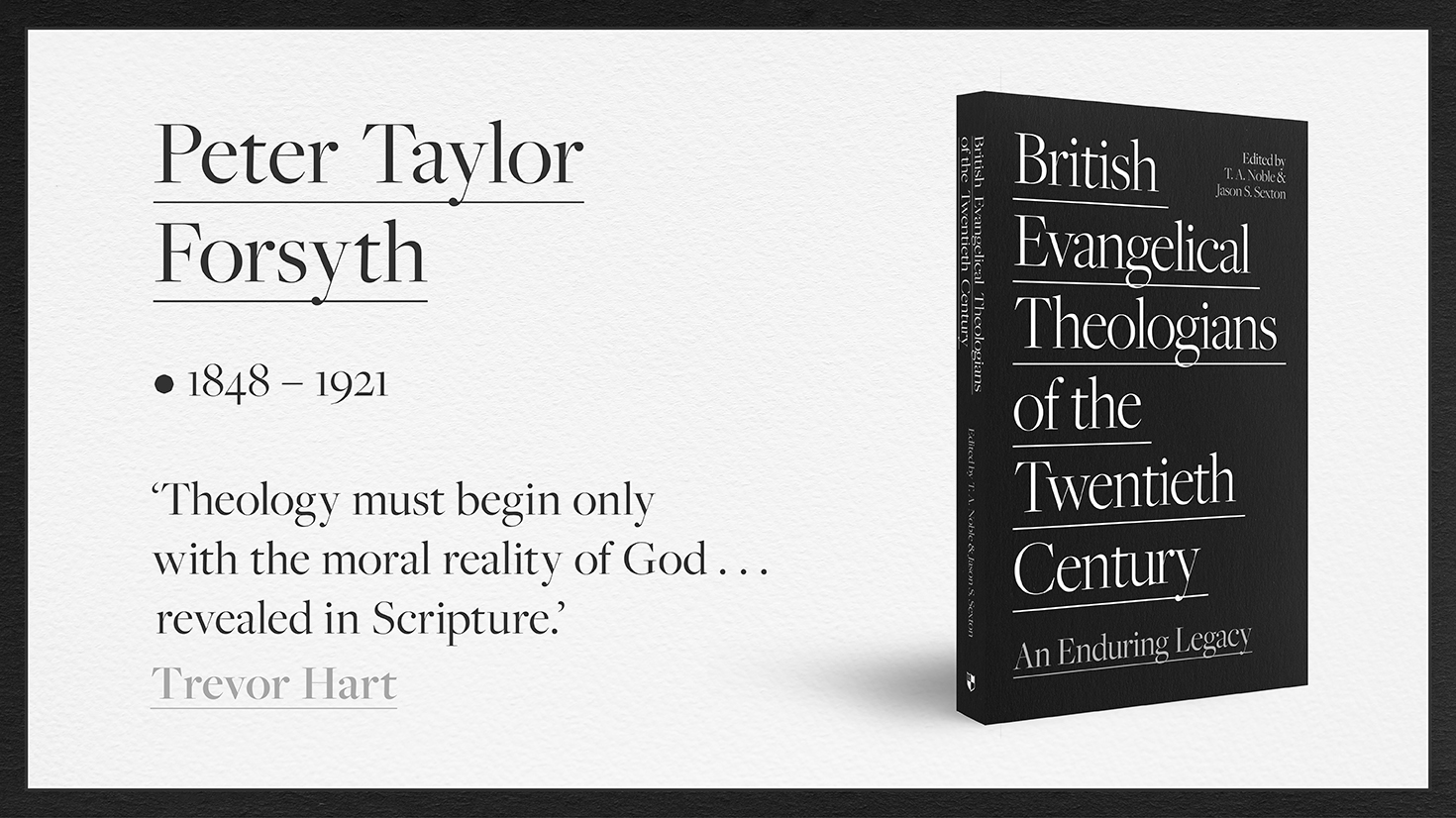
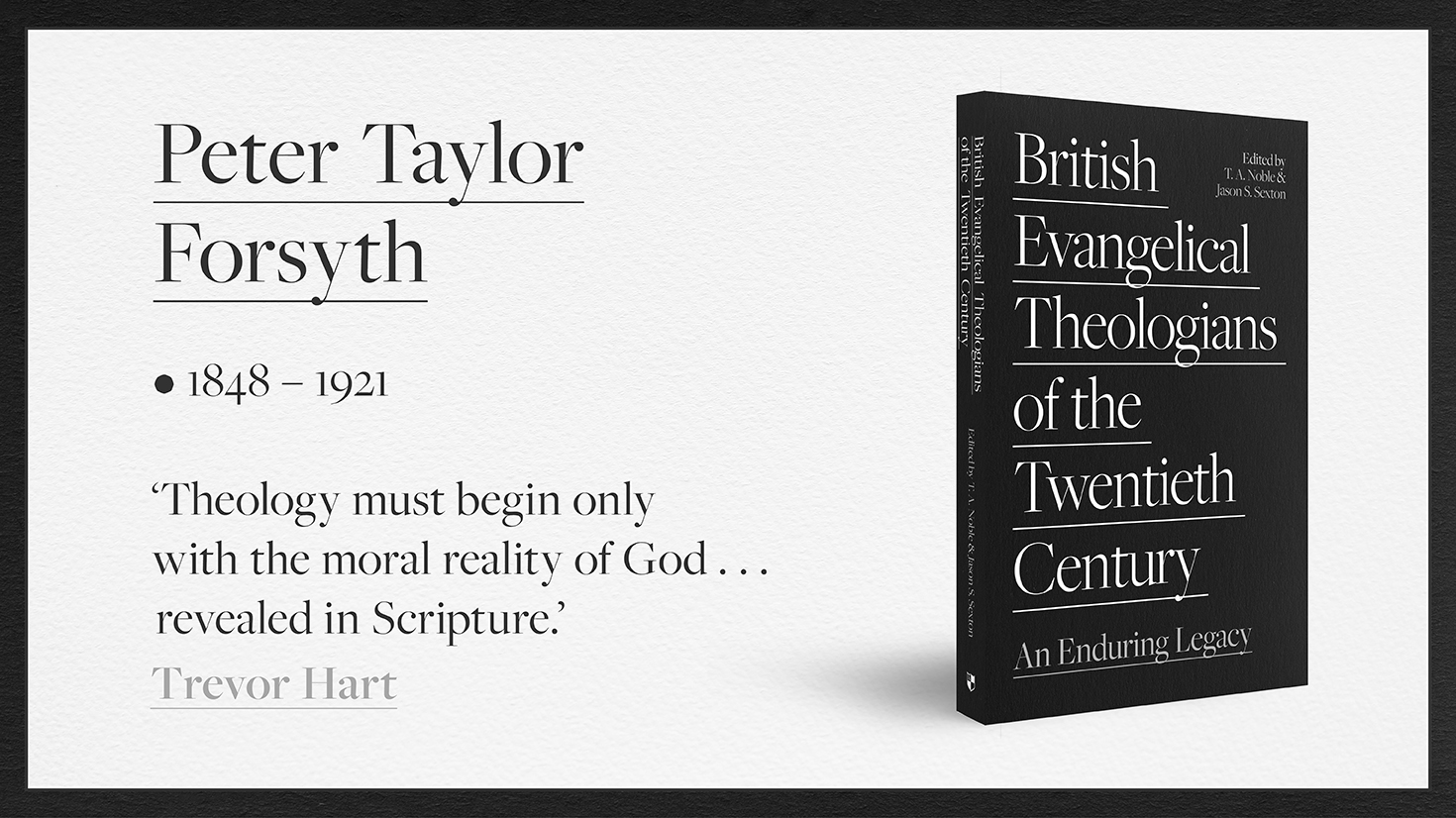
As one of the British Evangelical Theologians from the earlier part of the Twentieth Century, Forsyth's influence is well worth reflecting on. Trevor Hart's chapter in British Evangelical Theologians of the Twentieth Century, edited by T. A. Noble and Jason S. Sexton, is a good place to start. You can order your copy in paperback or ebook now.
Related Posts
Categories
Recent Posts
3

IVP Authors at Keswick Convention 2026
18 Jul 2026
Support IVP with your donation
Either donate with a one-off donation or subscribe monthly.
Choose a type of donation
I want to donate
 I want to donate