




 I want to donate
W. E. Sangster: British Evangelical Theologian of the Twentieth Century
- Tom Creedy
- In Remembrance
- 24 May 2022
-
804views

In his entry on Sangster in The Biographical Dictionary of Evangelicals, D. R. Owen writes:
William Edwin Robert Sangster was a British Methodist minister, who became known for his preaching and writing ministry. The central focus of his theology was not only the need for all people to be saved, but also the typical Wesleyan notion that Christians needed to strive for holiness, or what John Wesley described as Christian Perfection or Scriptural Holiness. He was convinced that if the church were to preach this message, societies would be completely transformed. He therefore strongly challenged the immorality and secularism that, in his judgment, were eroding post-war British society. He captivated large audiences with his uncompromising message and took it to the masses through the publication of his sermons in the national press.
William Sangster was born on 5 June 1900 near City Road, London. He was a natural scholar at school and a keen reader, and at the age of nine he was awarded a scholarship to Hoxton Central School. Sangster was introduced to the Christian faith when, from about 1909, he became associated through a friend with Radnor Street Mission, a Methodist Hall. It was here that he encountered the theology of John Wesley, particularly the doctrines of the assurance of salvation and Christian perfection. (It was here also that he met his future wife, Margaret Conway.) During a prayer meeting at the Mission in October 1913 he made a commitment to follow Jesus Christ. His main aim then became the sharing of his faith. He preached his first sermon at the Mission when he was sixteen years old. A year later he became a fully accredited local preacher. Family circumstances forced Sangster to leave school at fifteen, and he took up the position of office boy at a London accountancy firm. He first felt called to the Methodist ministry at the age of seventeen.
In June 1918 Sangster joined the army, and he served with the Queen’s Royal West Surrey Regiment. He was considered for a commission, but was rejected because some of the officers did not want a ‘holy Joe’ in the mess. He missed the horrors of the Western Front and in 1919 was sent to Germany. While he was there a Methodist padre encouraged him to offer himself for ordination.
In 1920 Sangster began to attend Handsworth College, Birmingham, but he later moved to Richmond College. In April 1923 he was sent to deputize for the Revd William Tapper at the County Road Methodist Church in Liverpool, and in August of that year he was sent to Littlehampton in Sussex as a probationer minister in the Bognor circuit. He was ordained in Wesley Chapel, Priory Street, York on 27 July 1926, and was married soon after. His first appointment as an ordained minister was to Conwy in North Wales. A year into his ministry there, he completed his BA degree externally through London University.
In 1929 Sangster took over the Methodist church in Aintree, Liverpool. By this time he was recognized as a preacher, and was able to draw crowds of up to 700 people. In 1930 he began making final preparations to complete an MA degree. However, his health failed so that he could not complete the degree, and he entered a period of spiritual crisis. He became self-critical, blaming himself for being ambitious, and began to seek a special blessing, which he believed would come through prayer and striving after holiness. Drawing on his Wesleyan theology, he reached the conclusion that he needed God’s grace in every aspect of his life and therefore to be entirely sanctified, and in 1931 his quest culminated in a deep experience. His first book, Why Jesus Never Wrote a Book, explains his new understanding of holiness.
In 1932 Sangster moved from Merseyside to the Queen Street Central Hall, Scarborough. He was moved in 1936 to the Brunswick Church in Leeds, known as a Methodist ‘cathedral’. In 1937 he finally completed his MA and became an external examiner to Richmond College in ethics and philosophy. Following the death of the Revd Dr Dinsdale Young of Westminster Central Hall, London in January 1938, Sangster was appointed to replace him, and he moved there in 1939.
During the Second World War, Central Hall became a refuge for many through Sangster’s work among those who had lost everything during the blitz. He also drew vast crowds to services. In 1942 he completed his doctorate (PhD, London University), which was later published under the title The Path to Perfection. By the end of the war, Sangster had become a national figure, being known particularly for his pronouncements on moral and social issues. He was also respected for his simple yet direct preaching.
Sangster was elected president of the Methodist Conference for 1950–1951. He was concerned about the decline in the number of local preachers, and put forward the idea of ‘schools for preachers’ for both ministers and laymen. At the ministerial session of Conference he pleaded with his colleagues to preach ‘Scriptural Holiness’, arguing that it was vital for there to be a distinct difference in behaviour between church members and society in general.
Sangster’s mind was focused on the need for spiritual revival, and he eagerly participated in evangelistic crusades, sharing platforms with (for example) Billy Graham and Alan Redpath. He was increasingly convinced that Methodism’s task was to ‘spread Christian holiness throughout the land’. He stated: ‘Methodism’s task will remain unfinished until all the ransomed church of God has seen this gleaming facet of truth.’
Sangster was forthright in denouncing what he regarded as the evils of post-war society. In 1953 he made headline news with the publication of his sermon entitled, ‘What would a Revival of Religion do for Britain?’ In it he claimed that Christ was the ultimate solution for the problems of society and that Christianity was the ‘buttress of decency’.
In 1954 Sangster was elected secretary of the Home Mission Department. He held ‘Schools of Evangelism’, day conferences to train ordinary people to share their faith with others. He also established the ‘Prayer Life Movement’. Prayer cells were formed, and within a year they had over 2,000 members. By the end of 1957 it was apparent that Sangster’s health was failing, and by the Conference of 1958, it was clear that he was seriously ill. He was later diagnosed as suffering from progressive muscular atrophy. He died on 24 May (Wesley Day), 1960.
Sangster had a deep passion for souls. His preaching was characterized by the call for personal salvation, but his Wesleyan heritage led him also to focus on holiness. He claimed that Luther’s ‘… immense (and Scriptural) stress upon faith-and faith only-was left unbalanced by the lack of a complementary passion for holiness’. He affirmed the ‘rich treasures of Catholic spirituality’, adding that Methodism was indebted to both Protestantism and Catholicism. This position did not compromise his distinctive evangelical commitment: he affirmed only that part of Catholicism, namely holiness, that he believed to conform with the essence of biblical Christianity.
More than anything else, Sangster was therefore a ‘herald of holiness’. He saw Entire Sanctification or Perfect Love as the greatest need of the Christian church. He maintained that ‘God can do so much more with sin than just forgive it’. In his Path to Perfection he claimed that ‘… there is an experience of the Holy Spirit, available to all who will seek it … which imparts spiritual power far above the level enjoyed by the average Christian …’ He was convinced that it was possible for a Christian’s heart to be made pure.
Sangster published very widely throughout his ministry. The major works that have had the most lasting impact are, The Path to Perfection (1943), The Pure in Heart: A Study in Christian Sanctity (1954) and the Westminster Sermons (1960, 1961). He published numerous devotional works and also contributed to many newspapers, including the Christian Herald, the Spectator and the Sunday Times.
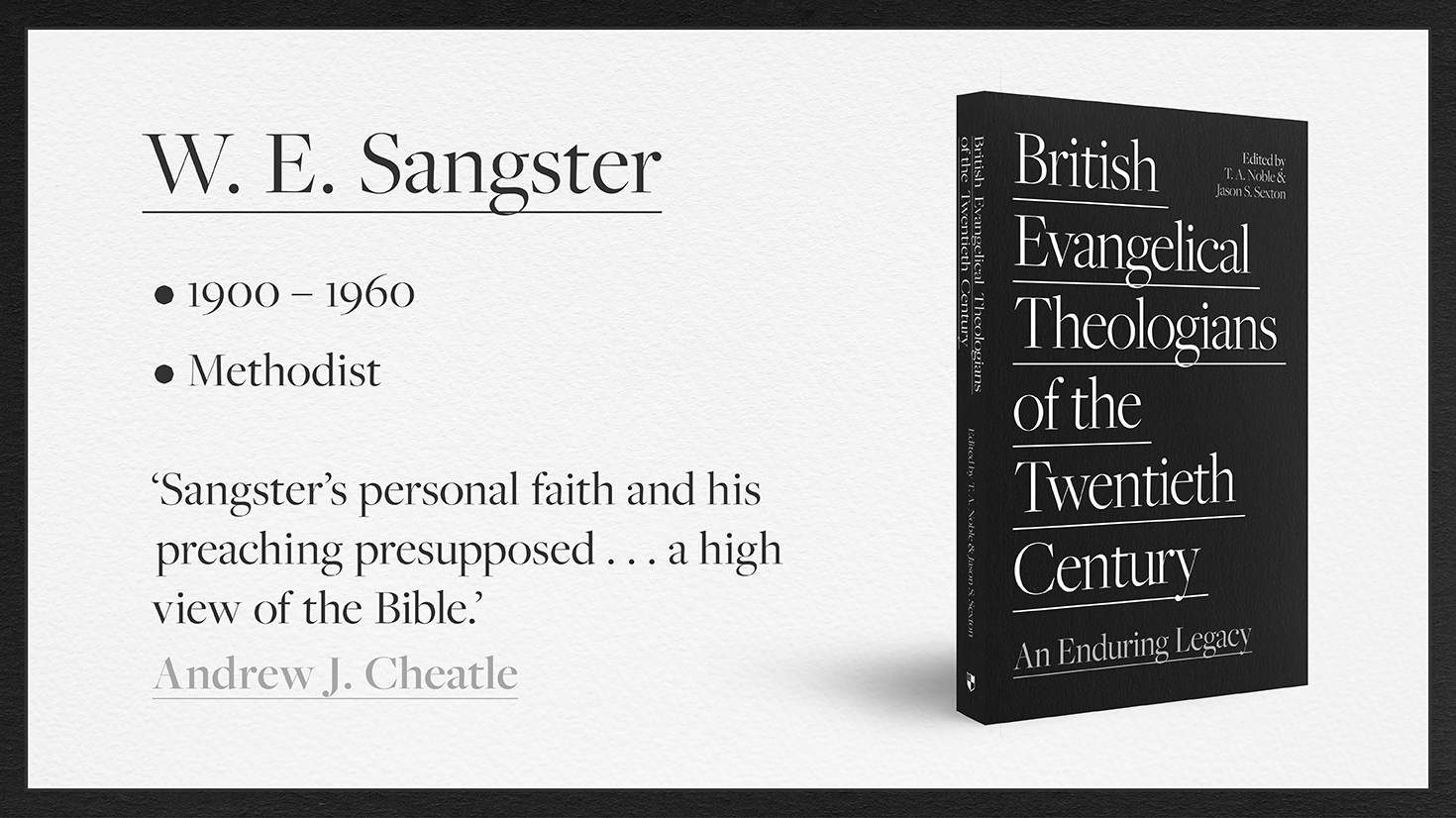
As one of the British Evangelical Theologians from the earlier-to-middle part of the Twentieth Century, Sangster's influence is well worth reflecting on. Andrew J Cheatle's chapter in British Evangelical Theologians of the Twentieth Century, edited by T. A. Noble and Jason S. Sexton, is a good place to start. You can order your copy in paperback or ebook now.
Related Posts
Categories
Recent Posts
3

IVP Authors at Keswick Convention 2026
18 Jul 2026
Support IVP with your donation
Either donate with a one-off donation or subscribe monthly.
Choose a type of donation
I want to donate
 I want to donate