



 I want to donate
Thomas F. Torrance: British Evangelical Theologian of the Twentieth Century
- Tom Creedy
- In Remembrance
- 30 Aug 2022
-
276views
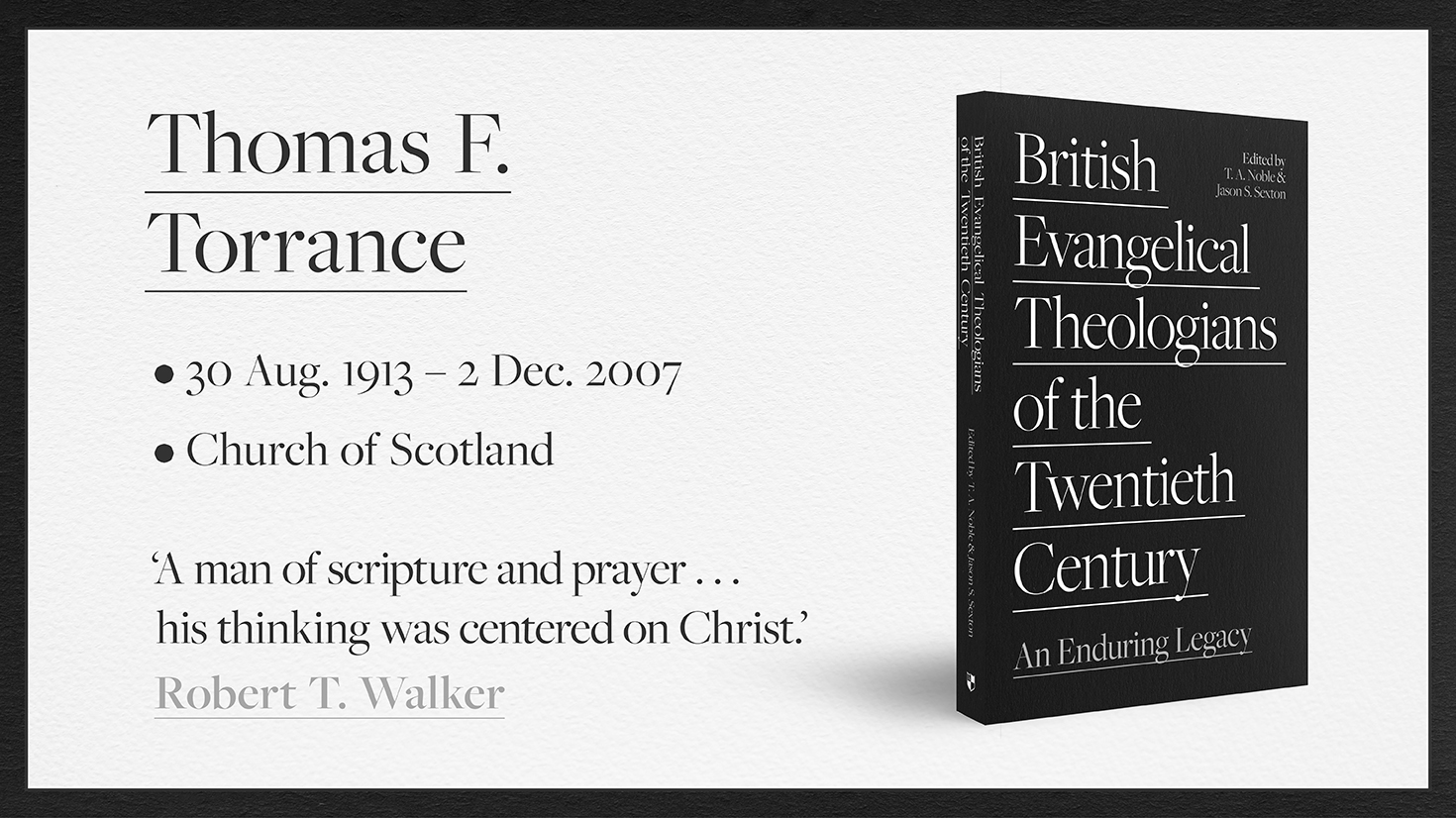
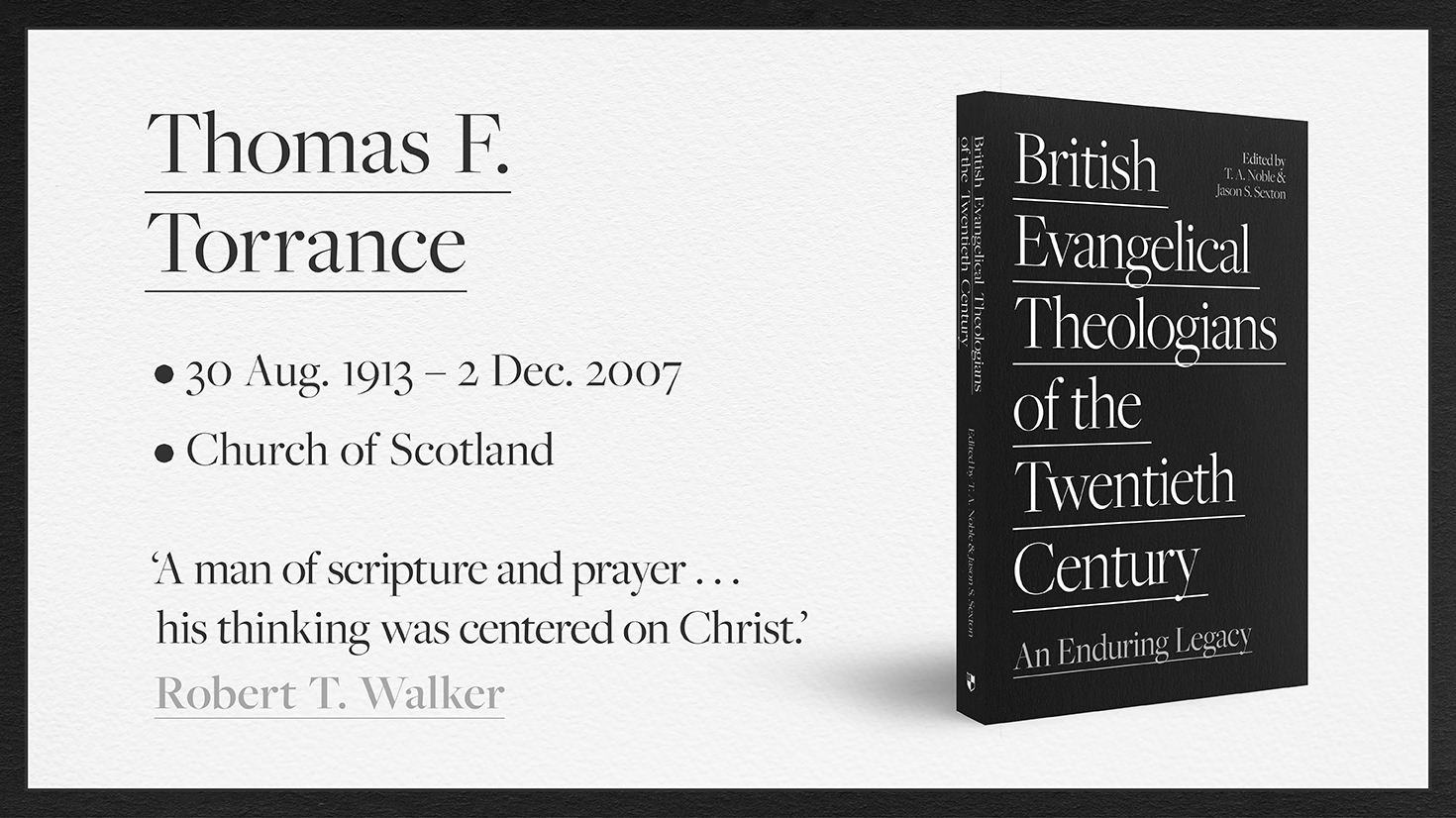
In the entry on Torrance in The New Dictionary of Theology: Historical and Systematic, J. L. McPake wrote:
The Scottish theologian Thomas Torrance was born in Chengdu, Sichuan, China, the son of missionary parents. He gained his MA (1934) and BD (1937) at the University of Edinburgh. Thereafter, Torrance studied under Barth at Basel, 1937–8. He was appointed Professor of Systematic Theology at Auburn Theological Seminary in 1938, but with the onset of the Second World War he returned to the UK and began further study at Oxford (1939–40). Torrance was ordained to the ministry of the Church of Scotland in March 1940, and saw service during the war years as a chaplain on the front line during the Italian campaign. He returned to Basel in 1946 and completed his doctoral thesis, The Doctrine of Grace in the Apostolic Fathers. He went back to parish ministry in 1947 before being appointed Professor of Church History at Edinburgh in 1950 and then to the Chair of Christian Dogmatics (1952–79). He was one of the founding editors of the Scottish Journal of Theology in 1948 and was co-editor (with D. W. Torrance) of Calvin’s NT commentaries. He served as Moderator of the General Assembly of the Church of Scotland in 1976, and received the Templeton Foundation Prize for Progress in Religion in 1978 in addition to eight honorary doctorates.
Torrance’s engagement with Barth dates, as noted above, from an early point in his career and is particularly evidenced in his books Karl Barth: An Introduction to His Early Thought 1910–1931 (London, 1962) and Karl Barth: Biblical and Evangelical Theologian (Edinburgh, 1990). In the former, Torrance established a paradigm for the interpretation of Barth which remains particularly influential in the English-speaking world. Further, he was co-editor (with G. W. Bromiley) of the English translation of Barth’s Church Dogmatics, which served to introduce Barth’s theology across the English-speaking world. Torrance’s interaction with, and interpretation of, Barth is fundamental to our understanding of his subsequent theological development.
The publication of Theological Science (1969) signalled the beginning of an exploration of the interaction between theology and natural science which is rooted in the same concerns that animated Torrance’s interpretation of Barth. That is, our concern is with ‘the actual knowledge of God’, disclosed by ‘God in His Self-revelation’, which is the ‘Self-disclosure in His Being and His Act’ (p. 350). Equally, Torrance is concerned to explore the nature of the discipline of theology, particularly in its interaction with the wider scientific community. Thus, he seeks to identify the place of theological science in relation to the natural sciences, particularly physics, whilst maintaining that: ‘Theology is the unique science devoted to the knowledge of God, differing from other sciences by the uniqueness of its object which can be apprehended only on its own terms and from within the actual situation it has created in our existence in making itself known’ (p. 281). Torrance further developed his understanding of this relation in a series of books,drawing on the parallel thinking on scientific epistemology by the Hungarian chemist, Michael Polanyi.
Integral to Torrance’s theological work has been his commitment to the *church, as witnessed to in his participation in the life of the Church of Scotland and concern for the Reformed theological heritage of his native land, exemplified in his early works The Mystery of the Lord’s Supper (1958) and The School of Faith (1959). The Special Commission on Baptism of the Church of Scotland (1955–62), of which he was convener, shaped the law, practice and understanding of *baptism within the church for more than a generation, and is deserving of renewed study. Further, Scottish Theology (Edinburgh, 1996) offers a particular interpretation of the Scottish theological tradition which seeks to integrate it into an overarching and comprehensive schema.
Interwoven with this is Torrance’s concern for the fullness of the life of the church and in particular with Faith and Order considerations, and this is demonstrated in the collected papers, Conflict and Agreement I (1959), Conflict and Agreement II (1960) and in Theology in Reconciliation (1975), as well as by his ongoing commitment to ecumenical dialogue. Of especial note is his concern for dialogue with the Orthodox Church, and the tradition of the Greek Fathers, as exemplified in the edited papers, The Incarnation: Ecumenical Studies in the Nicene-Constantinopolitan Creed A.D. 381 (1981), Theological Dialogue between Orthodox and Reformed Churches I (1985) and Theological Dialogue between Orthodox and Reformed Churches II (1993), as well as in Trinitarian Perspectives (1994).
This acknowledgment of the place of the Greek Fathers is profoundly reflected in Torrance’s concern for the maintenance of the Christian faith as expressed in the Nicene-Constantinopolitan Creed (ad 381), and in his appreciation of the theological contribution of Athanasius in securing the identity of the Son of God as consubstantial with that of the Father. In The Trinitarian Faith (1988), Torrance states that he regards the Creed as ‘essentially the fruit of Eastern Catholic theology’ and that: ‘The basic decision taken at Nicaea made it clear that the eternal relation between the Father and the Son in the Godhead was regarded in the Church as the supreme truth upon which everything else in the Gospel depends.’ Further, the identity of the Spirit as consubstantial with that of the Father and the Son is particularly developed ‘from the essential structure of knowledge of God grounded in his own self-communication through the Son and in the unity of the Spirit’ (pp. 2–3, 9).
Torrance’s class lectures, published posthumously as Incarnation (2008) and Atonement (2009), reveal the depth of Torrance’s thinking on what he always called the heart of his theology, the ‘vicarious humanity’ of Christ. But it was in the later part of his career after his formal retirement from teaching that Torrance emerged as a significant ‘theologian of the Trinity’ (Molnar). He advocated the view that a doctrine of the *Trinity which took its lead from Athanasius rather than the Cappadocians would avoid the difficulties which eventually led to the great division between the Eastern and Western churches on the filioque clause. Torrance also emphasized (in contrast to John Zizioulas) that the Son was begotten not from the ‘Person’ of the Father, but from the Being (ousias) of the Father, as explicitly stated in the original creed of the Council of Nicaea (325). The Being (ousia) of the Father could not therefore be regarded as some ‘impersonal’ substance, but as fully personal. Torrance was not a patrologist interested primarily in reproducing the doctrine of the Fathers, but a dogmatician who articulated an original and contemporary Reformed and evangelical reconstruction of patristic trinitarian theology.
Torrance’s trinitarian theology can be seen as taking into account the contributions of Barth and Rahner. But unlike Barth he writes of the distinct ‘Persons’ of the Trinity, distinguished and united by their ‘onto-relations’, and he is not prepared to allow ‘Rahner’s rule’ to be interpreted in such a way as to eliminate the transcendence of the Immanent Trinity. He sees some value in the concern of those who espouse the ‘social analogy’, but more strongly emphasizes the unity of the Trinity. He is not driven by the desire of some to make the doctrine of the Trinity ‘relevant’ to social and egalitarian concerns (as with Moltmann), but more concerned to see the deep integration of the doctrine of the Trinity with the Christian gospel and thus to articulate a trinitarian soteriology . The whole trinitarian shape of his theology is deeply permeated by his Reformation perspective that salvation is by grace.
Torrance’s contribution to theology is at once evangelical and catholic, Reformed and orthodox, in its breadth and scope. The concern to explore the possibility of our knowledge of God in the light of his self-revelation in Christ, complemented by the concern to enter into dialogue with the physical sciences, marks his theology as one rich in promise and potential in our contemporary age. Equally, the ecumenical implications of his theology require to be embraced in order that their depth may be fully comprehended. Torrance was undoubtedly the most prolific Scottish theologian of the twentieth century, and in the opinion of many, the most outstanding British dogmatician.
As one of the British Evangelical Theologians from the earlier-to-middle part of the Twentieth Century, Torrance's influence is well worth reflecting on. Robert T. Walker's chapter in British Evangelical Theologians of the Twentieth Century, edited by T. A. Noble and Jason S. Sexton, is a good place to start. You can order your copy in paperback or ebook now.
Related Posts
Categories
Recent Posts
3

IVP Authors at Keswick Convention 2026
18 Jul 2026
Support IVP with your donation
Either donate with a one-off donation or subscribe monthly.
Choose a type of donation
I want to donate
 I want to donate