





 I want to donate
Revising The Mission of God: Christopher J H Wright on God’s Magnificent Plan
- Rochelle Owusu-Antwi
- Blog
- 21 Jan 2026
-
326views
“The Bible is a very big book […] because there is a very big gospel--the good news of God’s very big plan, in which all of us have a small part to play.”
Christopher J H Wright
For the past three years I have answered questions about what I was working on at the time by saying, “I’m revising the mission of God,” before hastily clarifying that I was only revising my book about the mission of God. However, “…only revising” rather understates the size of the task and why it took so long. This extract from my Preface to the 2nd edition of The Mission of God, released in October, explains some of the reasons.
It is nineteen years since the first edition of this book was published. A lot has happened in the field of biblical theology of mission and missional hermeneutics of Scripture since then. In responding to the request of InterVarsity Press and many readers for a second edition, several objectives have clarified in my mind.
First, I have taken note of some of the reviews and critiques of the original work and, where appropriate, have sought to respond to them. In several places this has led me to offer further clarification or explanation at points where my earlier argument may have been susceptible to misunderstanding or misinterpretation.
One angle of critique has come from those who fear that my emphasis on a holistic understanding of mission (holding the evangelistic and social dimensions inseparably together), drawn from my reading of the Bible as a whole including the rich teaching of the Old Testament, results in a dangerously inadequate emphasis on the spiritual realities of human fallenness, divine judgment, and the prospect of a lost eternity from which Christ alone can save us. Seeking to correct what I see as a misunderstanding of my position in such matters, I have expanded my discussion into a separate chapter thirteen, “Gospel-Centered Integral Mission.”
Another line of critique focuses on the “linear” nature of my approach, seeing the whole Bible as one big story, a single grand narrative that renders to us the mission of God. This, it is argued, has an inbuilt theological assumption of supersessionism (or “replacement theology”--that the Christian church has simply replaced the Jews in God’s plans). R. Kendall Soulen views this as a major and perilous structural flaw of my presentation in the first edition. According to Collin Cornell, this “dramatic paradigm” for the whole Bible also obscures another major biblical center and theme, namely, God’s desire for loving communion with his creation, and also, by its unilinear progression toward an ending, builds in the danger of obsolescence, for Israel and even for the incarnate Christ--dangers which I believe I avoid. These are challenges that I address in a new chapter eight in this edition--“Election and Supersessionism.”
Then also, I have tried to take account of the ongoing conversation in the field of biblical missiology since 2006 and have been personally enriched by perusing some very significant contributions in the intervening years. The additional bibliography for this second edition is a testimony to the scale of the expansion of this field (the field now commonly designated “missional hermeneutics”), an expansion that is still ongoing. Titles marked by an asterisk in the bibliography are ones that have contributed to this revised and updated edition, mostly published post-2006. There are more than 190 of them! They can be blamed for the considerable increase in quotations and footnote references, which I hope have enhanced this edition.
So it was very encouraging when one of the peer reviewers gave his assurance that this second edition would be worth getting, even by those who have enjoyed the first. Similarly, a friend who teaches missiology in a British seminary wrote,
“I am finding your additional comments on recent scholarship exceptionally helpful. In my view, they make this new edition an excellent resource for students not only because of your thoughtful engagement with Scripture, but also because of your respectful and constructive interaction with scholarship, which highlights many of the key issues that students of missiology need to consider. I have been encouraging my students on both undergraduate and postgraduate programmes to read the new edition of your book. I hope it receives a very positive response.”
Well, time will tell if his hope is vindicated.
The title of the book is still the clue to the two passionate convictions that lie behind it: first, that whatever mission or missions we think we are called or sent to engage in, whether as individual Christians, or as a local church, or indeed as the global church, it all depends on and flows from the prior mission of God himself; and secondly, that it is the Bible as a whole, from beginning to end in the canonical shape that God has providentially gifted it to us, that renders to us what that mission of God is, for the blessing of all nations and all creation.
The first point, that mission is fundamentally God’s, generates both humility and confidence: humility because it is an astonishing privilege that God calls us to participate with him in what he is doing in the world through his Spirit, so let’s not imagine God is anxiously waiting for us to get the job done; and confidence because it is the mission of God and he will accomplish it - guaranteed!
“It is an astonishing privilege that God calls us to participate with him in what he is doing in the world through his Spirit.”
Christopher J H Wright
The second point dictated the shape and flow of the whole book, since it has long seemed to me that a biblical theology of mission should not be a matter of assembling a few well-known “missionary texts” that validate what we already think we should be doing in mission, but rather ought to align itself with the overarching narrative flow of the Scripture from creation to new creation, through the great moments of election, redemption, and covenant (in the Old Testament) and their fulfilment in Christ, the gospel, and the mission of the church in and to all nations in the New. The Bible is a very big book (which may be some excuse for the size of this one), because there is a very big gospel--the good news of God’s very big plan, in which all of us have a small part to play.
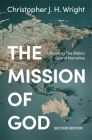
The Mission of God (Second Edition) is out now
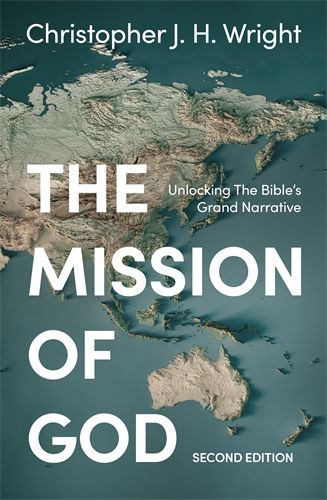
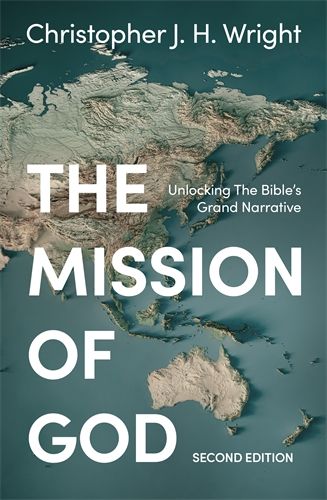
Chris Wright’s landmark book has shaped how many understand the Bible’s grand narrative and its call to global mission.
This updated second edition continues that work for a new generation, with revised content and fresh insights that reflect ongoing conversations in mission and biblical theology. A vital resource for church leaders, theologians, and anyone seeking to live missionally.
Related Posts
Related Products
The Mission of God
From £39.99
Categories
Recent Posts
4
Support IVP with your donation
Either donate with a one-off donation or subscribe monthly.
Choose a type of donation
I want to donate
 I want to donate