



 I want to donate
Reading the Bible as a foreigner
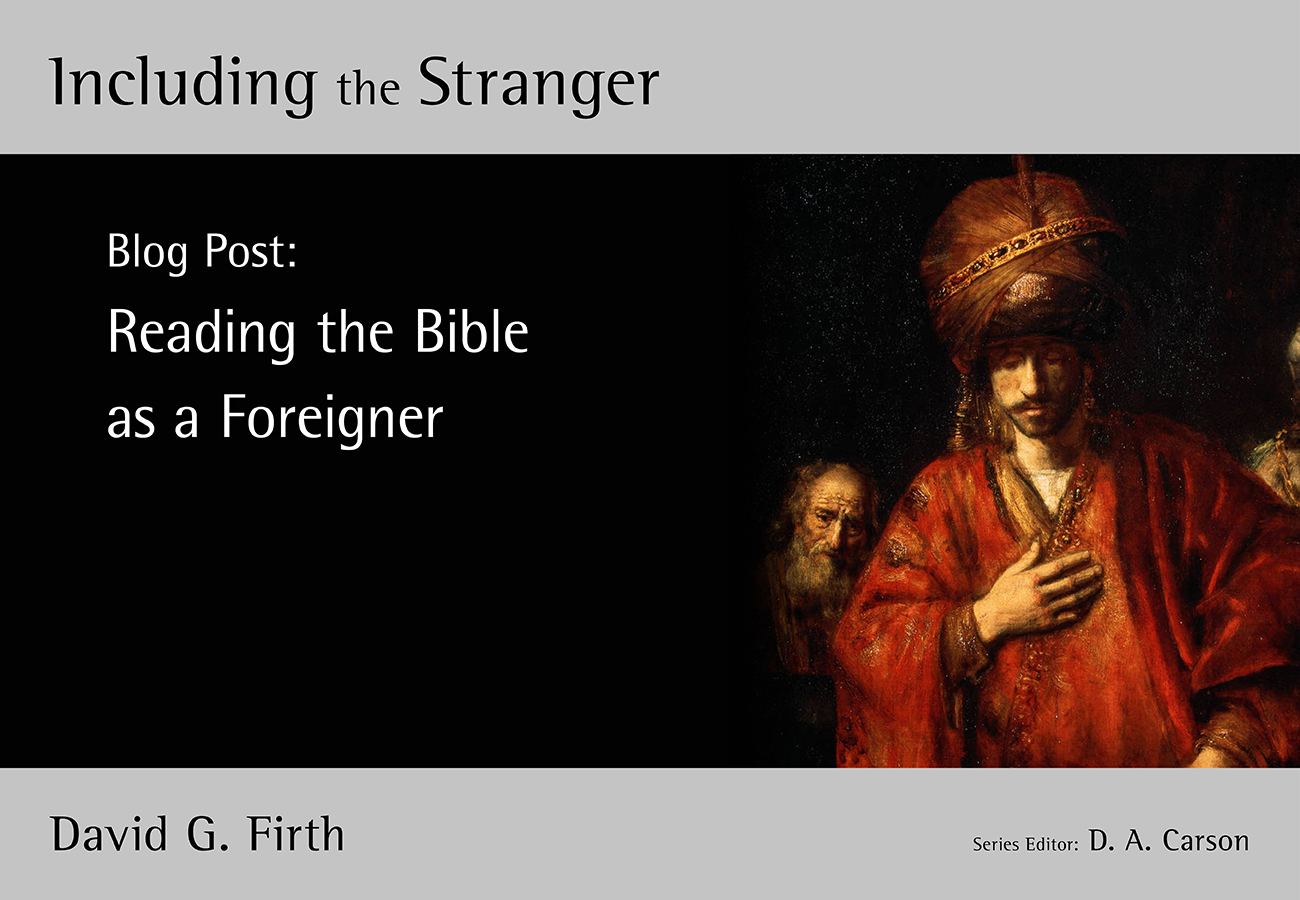
I am a foreigner. Almost any day when I speak to people I have not met before, I encounter an observation along the lines of ‘You’re not from around here are you?’ Since many British people seem unable to distinguish between an Australian, New Zealand or South African accent I am normally happy to string them along a little – though since I sometimes struggle to identify certain regional accents within the UK in spite of the years we have spent here, it is also quite common for us to spend time in a mutual attempt to work out where the other is from.
So, although I apparently do not look foreign (whatever that might mean!), the status of ‘foreigner’ is one that I constantly bear and which to varying degrees shapes my interaction with my community. Often that takes the form of good-natured teasing during certain sporting events, mostly from those I know well, though that is not entirely predictable. More problematic, though, are times when I or members of my family have attended meetings or events where ‘foreigners’ were blamed for a variety of ills. When we point out that we are foreigners, a response is usually given along the lines of ‘Oh, but you’re not the kind of foreigner I mean.’ Leaving aside the rather problematic concept of exactly what makes some foreigners acceptable and others not, it does indicate that host cultures are capable in some way of distinguishing between foreigners when needed, though equally that it is possible for foreigners to be treated as an undistinguished group. Extending the UK example, it is also possible to regard others as ‘foreign’ under some circumstances and as ‘native’ under others – for example, is someone English, Scottish or Welsh? Each of these can be distinct, yet, under other circumstances all these people would be ‘British’. Even within England, someone might be from Yorkshire or Cornwall, and so ‘not from around here’, although at other times their status as English would be stressed. In short, ‘foreignness’ (however defined) depends on the attitude of a speaker to another and whether someone is defined as ‘us’ or ‘other’ and this is something that can vary.
This is a non-scientific set of observations, but they form an important background to this study. It emerges out of a social context in which issues of migration and national social identity are widely discussed in the media across much of the Western world. As a migrant, I hope to bring some significant social benefits and skills to my host country. But I am always foreign, and no construction of British identity includes me just because the simple act of my speaking makes this clear. So, even though national identity within the UK can be constructed in a range of ways, some more inclusive than others, some of us cannot be included whereas others might live in a more marginal position in which they might be included under some constructions and not others.
My work as a biblical interpreter cannot be separated from this experience, perhaps because as with any reader my experience of the world makes me more aware of some themes within the Bible than others. That is, my social location could well have made me more aware of some themes within the Bible than I might have recognized had I been in another, though there is no real way of testing this. However, it could be said that one of the virtues of reading as a foreigner is that I see things that the dominant culture might not see, or perhaps ask questions that might not otherwise be posed, while conversely others can make me more aware of biblical themes that I might otherwise miss. The fact is that we all bring some degree of pre-understanding to the reading of the Bible, and though the emphasis on wissenschaftlich (scientific/critical) interpretation that emerged out of the Enlightenment discouraged this because of its belief that the interpreter must in some way be detached from the material, the reality is that readers have consistently brought their own political situation to bear on their reading of the Bible.
At the same time, it is not my contention that the position of the reader is to be absolutized such that this becomes the most important issue in interpretation. Rather, the situation of the reader and those questions for the Bible that emerge from a given reader’s social and political context are themselves to be brought into a dialogue with the Bible. It is through interaction with the Bible that our pre-understanding can be challenged and changed through the process of reading the text. This means that although I can reasonably aim for a degree of detachment as an interpreter I can never do so absolutely, and indeed to do so such that I miss certain elements of what is in the Bible is to lose the benefit that acknowledging my pre-understanding brings. At the same time, there will be points where the act of reading the Bible leads me to reassess those convictions with which I began the process of reading.
David's new contribution to the long-running NSBT series publishes on the 17th of November. You can preorder your copy now! David is a prolific writer, so below are some of his other books, or books he's contributed to/edited.
Related Posts

Categories
Recent Posts
4

UK Launch of Called to Care by Jo Knight
28 May 2026
5
May New Releases
18 May 2026
Support IVP with your donation
Either donate with a one-off donation or subscribe monthly.
Choose a type of donation
I want to donate
 I want to donate