




 I want to donate
Martyn Lloyd-Jones: British Evangelical Theologian of the Twentieth Century
- Tom Creedy
- In Remembrance
- 20 Dec 2022
-
279views

In the entry on Lloyd-Jones n in The New Dictionary of Theology: Historical and Systematic, I. H. Murray wrote:
Although born in Wales, Lloyd-Jones completed his education at Marylebone Grammar School and St Bartholomew’s Hospital, London. A distinguished career as a physician lay before him when, after severe inner struggle, he committed himself to the Christian ministry in 1926. Following a notable pastorate at Aberavon (1927–38), he was called as colleague and then successor to G. Campbell Morgan (1863–1945) at Westminster Chapel, London. He played an early leadership role in the Inter-Varsity Fellowship (now UCCF) and was also involved in the founding of such new evangelical agencies as the Evangelical Library, the London Bible College and the International Fellowship of Evangelical Students.
While he gave much time to helping students, ministers and missionaries, the pulpit was Lloyd-Jones’s most important work. By authoritative exposition and application of the Scriptures he sought to restore the true nature of *preaching, rejecting the prevalent opinion that scientific knowledge had outmoded commitment to the inerrancy of Scripture (see *Infallibility). He saw faith in the word of God and dependence upon the Holy Spirit as the foremost needs in contemporary Christianity, and regarded human unbelief as moral rather than intellectual (see his Truth Unchanged, Unchanging, London, 1951). He reintroduced consecutive expository preaching, with subsequent publications on The Sermon on the Mount (London, 1959–60), Ephesians (Edinburgh, 1974–82), II Peter (Edinburgh, 1983) and Romans (London and Edinburgh, 1970–). But the majority of his preaching was evangelistic as he itinerated constantly for over fifty years (including Europe and the United States in summer vacations).
Thoroughly committed to Calvinistic Methodism, Lloyd-Jones’s ministry did not harmonize with the prevailing religious ethos in Wales or England, and while constantly helping many evangelical agencies, his convictions on the importance of *Reformed theology kept him from any full identification. He was, however, closely involved with a resurgence of interest in Reformed theology commenced through the IVF, the Puritan Conferences and the Banner of Truth Trust (subsequently to be his principal publisher).
In his later years, faced with a general decline of Christianity in England, Lloyd-Jones called for the priority of evangelical unity above denominational loyalties. He did not propose a new denomination, but urged the importance of the true unity of churches (which he hoped to see expressed in the British Evangelical Council) and warned that evangelical neutrality to the ecumenical movement was contributing to the spread of low views on saving faith.
Resigning from Westminster Chapel in 1968, he remained active in preaching and in the preparation of sermons for publication until shortly before his death. By his preaching and books he profoundly influenced the whole English-speaking world, as one who stood in the tradition of the Reformers and Puritans, Whitefield, Edwards and Spurgeon. Emil Brunner once described him as ‘the greatest preacher in Christendom today’.
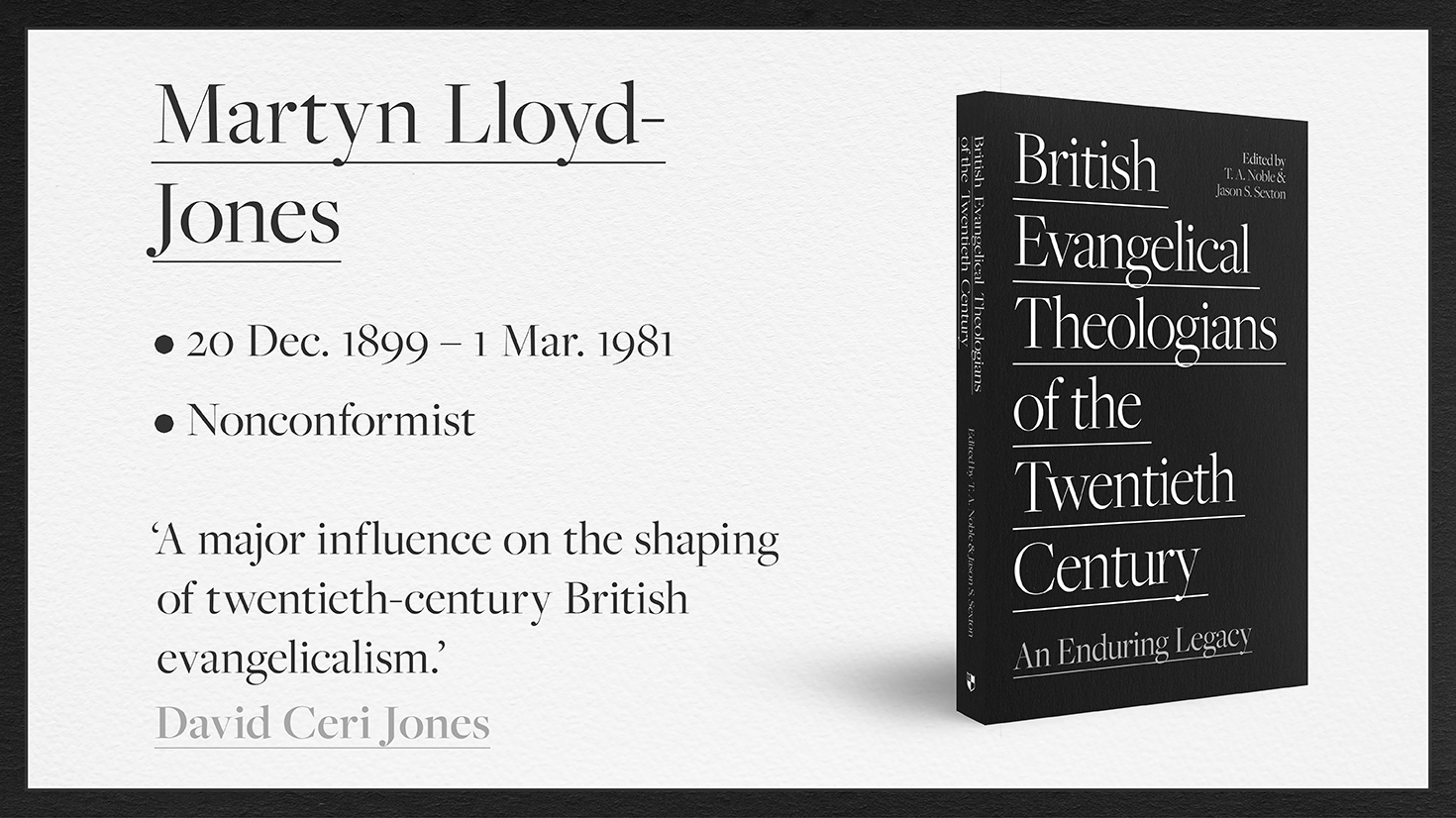
As a key British Evangelical Theologian of the middle part of the Twentieth Century, Lloyd Jones' influence is well worth reflecting on. David Ceri Jones' chapter in British Evangelical Theologians of the Twentieth Century, edited by T. A. Noble and Jason S. Sexton, is a good place to start. You can order your copy in paperback or ebook now.
Related Posts
Categories
Recent Posts
3

IVP Authors at Keswick Convention 2026
18 Jul 2026
Support IVP with your donation
Either donate with a one-off donation or subscribe monthly.
Choose a type of donation
I want to donate
 I want to donate