




 I want to donate
Lucian of Antioch: The Real Rallying Point for Anti-Nicene Theology?
- Tom Creedy
- New Releases
- 17 Sept 2021
-
340views
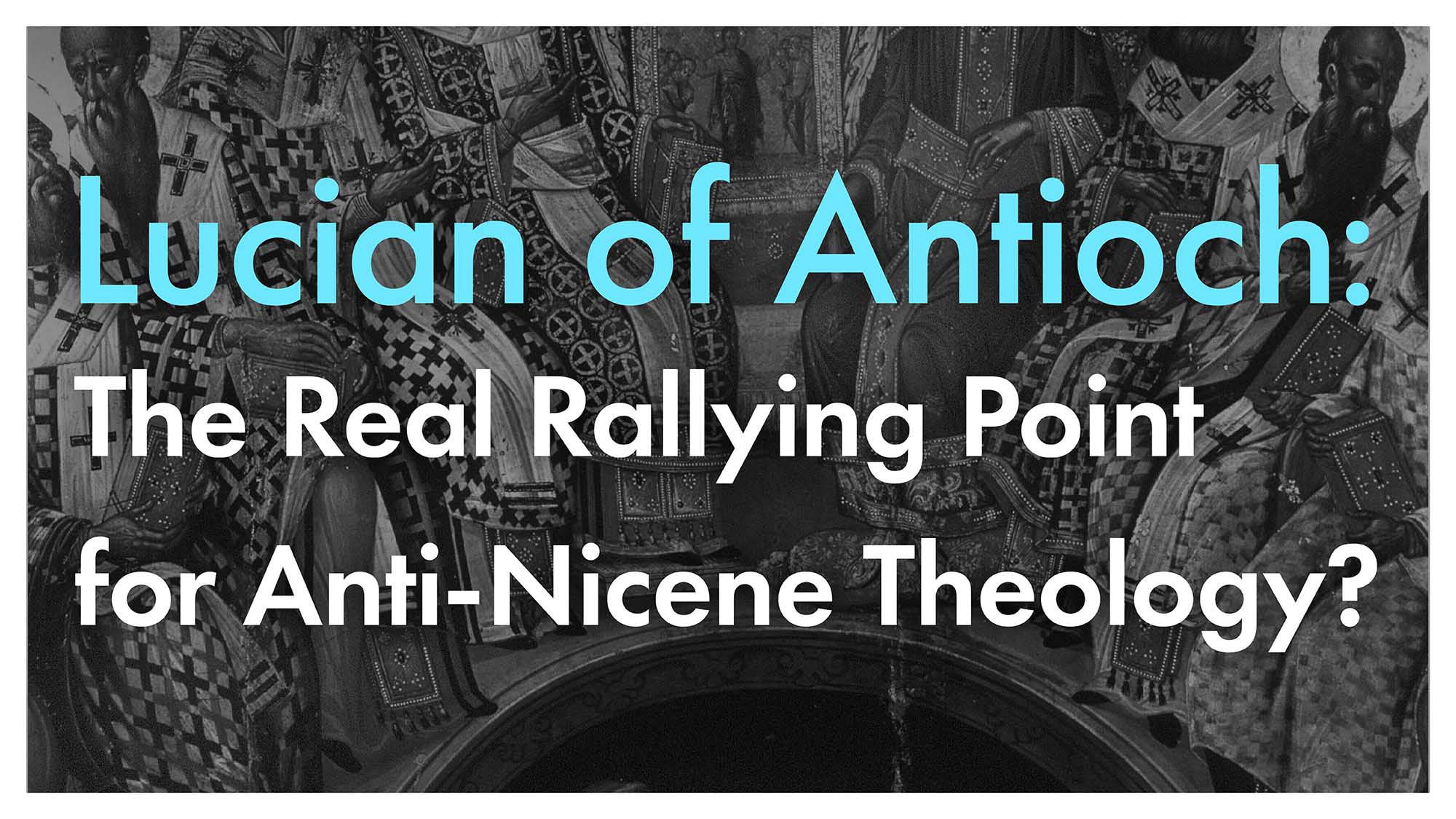
One of the great benefits of spending time reading and thinking about historical theology is the partial insight it gives into the lives and writings of believers who came before us, some of whom would not otherwise have been known to us.
There was one theologian in particular who caught my eye during this research: Lucian of Antioch. One of the most interesting things about Lucian is that it appears that it was he, and not Arius, who was the rallying point for theologians and bishops who were uncomfortable with some of the elements of the confession composed at Nicaea in 325. Among the statements that cause disquiet for some were the propositions that the Son is begotten from the essence of the Father and was identical in essence (homoousion) to the Father. Statements such as these were viewed as compromising the distinction between the Son and the Father undergirded by an understanding of the Son as the image of the Father traced to the Son’s generation from the Father and not from the Father’s gift of himself to the Son.
Lucian (c. AD 240-312) is a shadowy and fascinating figure about whom little is known for sure. However, quite a strong case can be made to view him as the leading representative of the theological tradition of which Arius himself was a particularly radical member. There are four important avenues of insight into Lucian which, when held together, suggests that he was the figure around whom a broader alliance could be formed in resistance to Nicene theology.
First, during the controversy between himself and Alexander of Alexandria regarding the status of the Son in relation to the Father, Arius wrote a letter to the influential and well-connected bishop Eusebius of Nicomedia. Arius’ attempt was to secure a powerful ally to underwrite his assertions that that the Son, as begotten, is brought into being such that there was a time when the Son did not exist (so to secure the untrammelled and unique sovereignty of the one God). In this letter, Arius described himself as a ‘Lucianite’.[1] This is very important: not only did Arius use Lucian by which to locate himself on the smorgasbord of theological possibilities, he also played this card to secure broader support. Ostensibly, then, Lucian was a figure who garnered the loyalty of at least some of the bishops and theologians of the early fourth century.
Second, and in line with this, the fifth century historian Philostogorius presents Lucian, and not Arius, as the true rallying point for bishops who demurred from the Nicene confession of 325. It would appear that - after the 325 Council and the thorough hatchet job undertaken on Arius’ theological convictions that took place there - the theological tradition uncomfortable with elements of the Nicene confession did not coalesce around Arius and his rather extreme doctrine of the Son’s dissimilarity in essence to the Father. Indeed, as the indignant letter of the anti-Nicene bishops in response to Julius of Rome’s description of them as ‘Arian’ says ‘we have not been followers of Arius – how could Bishops, such as we, follow a Presbyter? – nor did we receive any other faith besude that which has been handed down from the beginning’.[2] Despite the attempts of Athanasius to narrate the post-Nicene disputes as between the Christians and the Arians (or the ‘Ariomaniacs’), this is not necessarily the reality. It would appear possible that many who were uncomfortable with the Nicene confession traced their lineage not to Arius, but to Lucian.
Third - building on the possibility that it was Lucian and not Arius who fuelled the continuing resistance to the core Nicene propositions that the Son is begotten from the essence of the Father as God from God, light from light – the significant confession known as the Second Creed of the Dedication Council is described as ‘the Lucianite Creed.[3] It is hard to overestimate the significance of the Second Creed of the Dedication Council as a viable alternative to the Nicene confession. Indeed, it remained the classic statement of the resistance to Nicene theology with the potential to form a consensus around it for the following decades of the fourth century. In terms of doctrine, there is clear daylight between the theological convictions of this confession and those that can be attributed to Arius. There is no suggestion that the Son is brought into being from nothing and, instead, an affirmation that the Son is the exact image of the Father. However, it remains a subtle subordination of the Son to the Father by removing the clause that the Son is begotten from the essence of the Father thus opening the door to the possibility that the Son is like the Father by the gift and grace of the Father (a participatory image Christology) rather than by nature (a constitutive image Christology).
Finally, a specific doctrine that is applied to Lucian proved to have powerful sway on Arius. The core doctrine attributed to Lucian is that, at the incarnation, the Son took on a human body without a soul.[4] The Son indwelt a human form and energized it and acted through it in space and time. As an application of this conception of the incarnation, Lucian was able to make the following proposition: the limitations of the incarnate Son are not a consequence of his full humanity, but of the attenuated divinity of the Son himself. That is to say, the Son is not limited because he is incarnate; the Son is limited because he is not God. This was a powerful theme in Arius’ writings and affected his doctrine of salvation directly.
The Unbegun [the Father] made the Son a beginning of things originated;
And advanced Him as a Son to Himself by adoption.
He has nothing proper to God in proper subsistence.
For he is not equal, no, nor one in essence with Him.[5]
Here, The Son is not God by nature. Instead, he is adopted to participate in divinity by the gift of the Father as a blessing for his incarnate obedience. Created being lifting itself to share in divinity. A Nicene theology of salvation reverses this by affirming the full divinity of the Son who assumes a full human nature into union with himself wherein God the Son lives the life of the Son as one of us and in so doing draws us by grace to share in that which he is by nature.
[1] Arius, Letter to Eusebius of Nicomedia, in Nicene and Post Nicene Fathers II.3, recorded in Thedoret, Ecclesiastical History, 1.4.
[2] Letter recorded in Athanasius, On the Synods, 22 and Socrates, Ecclesiastical History, 2.10.
[3] Sozomen, Ecclesiastical History, 3.5.
[4] Epiphanius of Salamis, Anacoratus, 33-35.
[5] Arius, Thalia recorded in Athanasius, On the Synods, 15.
Related Posts
Categories
Recent Posts
4
Support IVP with your donation
Either donate with a one-off donation or subscribe monthly.
Choose a type of donation
I want to donate
 I want to donate