



 I want to donate
James Denney: British Evangelical Theologian of the Twentieth Century
- Tom Creedy
- In Remembrance
- 12 Jun 2022
-
308views
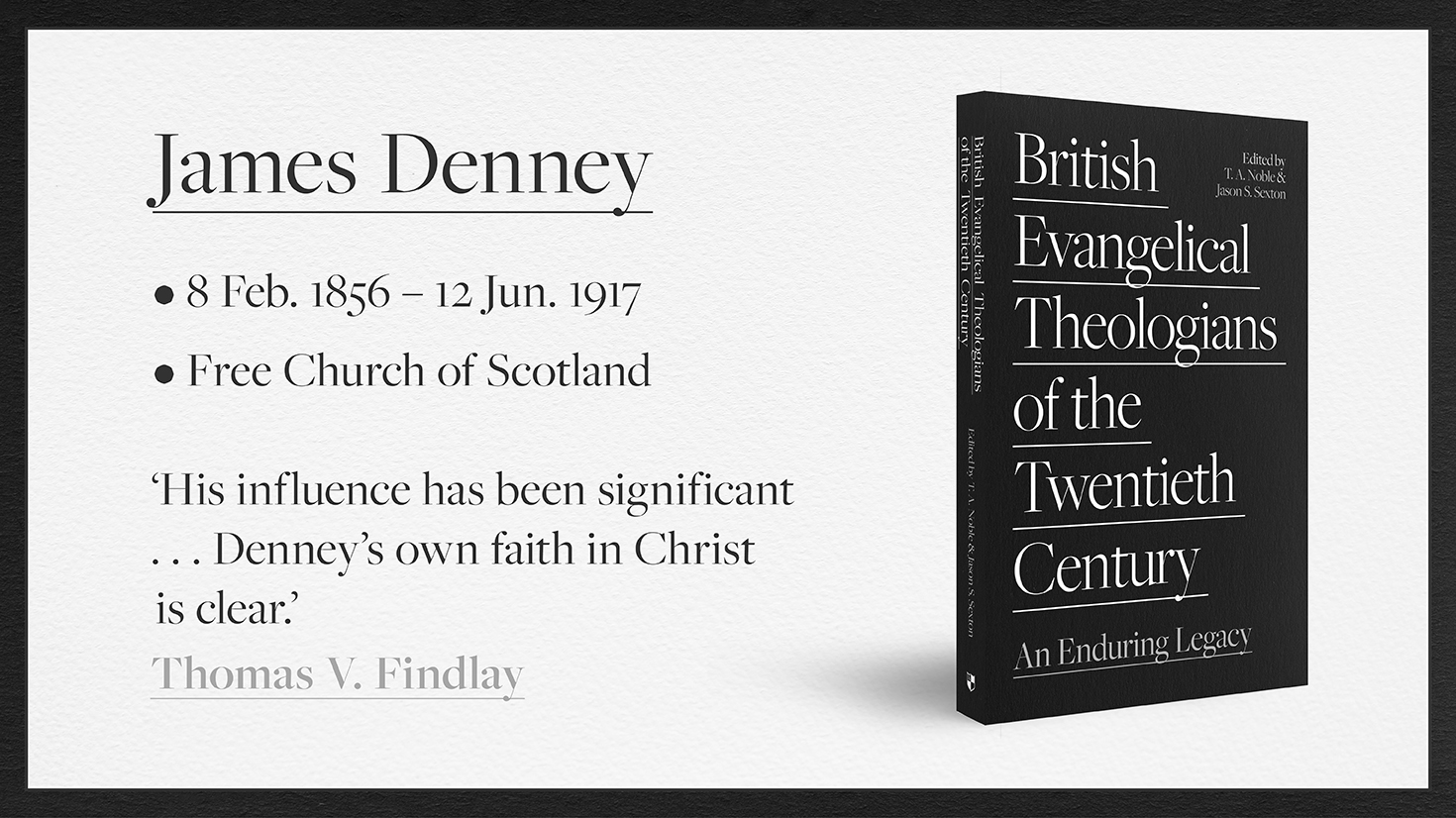

In his entry on Denney in The Biographical Dictionary of Evangelicals, D. A. Currie writes:
A Scottish theologian and New Testament scholar, Denney was born in Paisley on 5 February 1856 into a working-class Reformed Presbyterian family and grew up in Greenock. At the age of eighteen he began a brilliant career at Glasgow University, earning a rare ‘double first’ in classics and philosophy upon graduating with an MA in 1879. That same year he continued his distinguished student career, under the direction of professors such as the New Testament scholar A. B. Bruce, at the Free Church College in Glasgow, a natural choice for his theological studies since most of the Reformed Presbyterian Church had united with the Free Church of Scotland in 1876. Denney received his BD in 1883 and spent the next three years as a missionary at Free St John’s Church in Glasgow.
He was ordained in 1886 when he was called to become the minister of the East Free Church of Broughty Ferry, a suburb of Dundee. Later that year Denney married Mary Carmichael Brown. While the marriage produced no children, it did have a lasting effect upon Denney’s theology. Through her own convictions and example, and especially by introducing him to the works of the pre-eminent English Baptist preacher C. H. Spurgeon, Denney’s wife encouraged him to move away from the kind of ‘broad churchism’ championed by Bruce towards a more distinctively evangelical approach.
Although Denney carried out his parish duties, including the conduct of regular church prayer meetings, with care and conviction, his primary gifts were as an expositor and preacher. Two series of sermons for his congregation in Broughty Ferry were the basis of his earliest publications, The Epistles to the Thessalonians (1892) and The Second Epistle to the Corinthians (1894), which appeared in the Expositor’s Bible series of commentaries edited by his friend Sir W. Robertson Nicoll. Chicago Theological Seminary recognized Denney’s broader theological abilities by granting him a DD and issuing an invitation to deliver a series of lectures in 1894, which were published as Studies in Theology.
In 1897 Denney returned to academic life full time when he accepted an offer to become Professor of Systematic and Pastoral Theology at the Glasgow Free Church College. Two years later he succeeded Bruce as Chair of New Testament Language, Literature and Theology, and in 1915 Denney was elected principal of the college by acclamation of the United Free Church General Assembly. He was by no means the only outstanding evangelical scholar on the faculty. During his tenure, James Orr succeeded him to the theological chair, and George Adam Smith taught Old Testament. Noted for his clear and epigrammatic writing style, Denney published extensively throughout his academic career, particularly in the periodicals The Expositor and The British Weekly. His primary works include The Expositor’s Greek Testament commentary on Romans (1900), The Death of Christ (1902), The Atonement and the Modern Mind (1903), Jesus and the Gospel (1908), The Church and the Kingdom (1910) and The Christian Doctrine of Reconciliation (1917).
Despite this prodigious scholarly output and his reputation as a teacher as demanding upon himself as upon his students, Denney remained an active churchman throughout his life. On most Sunday mornings and evenings he could be found filling a pulpit somewhere in Scotland. He participated in the negotiations that led to the union of the Free Church and the United Presbyterian Church in 1900 and later served as Convenor of the Central Fund of the resulting United Free Church, helping to raise the minimum stipends of its ministers. Denney was also an ardent advocate of the evangelical social cause of prohibition during the First World War, writing and speaking on behalf of the Scottish Temperance League. By no means narrow in his outlook, he took great delight in literature, occasionally writing and lecturing on his favourite authors: Shakespeare, Dickens and Robert Burns.
After collapsing while lecturing to one of his classes in February 1917, Denney died from respiratory complications on 11 June 1917 at the age of sixty-one. His extensive influence was summed up on a memorial plaque in what is now Trinity College, Glasgow: ‘supreme alike as scholar, teacher, administrator, and man of God, to whom many owed their souls’.
Denney’s relationship with evangelicalism has been somewhat ambivalent on both sides, with Denney expressing reservations about elements of evangelicalism, and evangelicals questioning aspects of Denney’s thought. His commitment to seeing people enter into a life-transforming relationship with Jesus Christ was central to his life and theology: ‘I haven’t the faintest interest in any theology which doesn’t help us to evangelize’ (Taylor, God Loves Like That!, p. 29). Thus he could use the Westminster Shorter Catechism as a basis for a Bible class because it was excellent ‘for evangelizing’ and hold American evangelists D. L. Moody and Ira Sankey in high regard. Yet Denney resisted being categorized as a Calvinist or even as ‘orthodox’. He adopted this position in part because he suspected all theological and metaphysical systems, conservative and liberal, of obscuring Christ and becoming an obstacle to heartfelt faith. None the less, he seems to have made what he viewed as radical theologians and biblical scholars, particularly Albrecht Ritschl, the primary targets of his critiques.
Denney did not defend traditional interpretations of Scripture because he was a traditionalist, but because he believed they were true to the texts and could lead people to faith in Christ. He was always more comfortable as an exegete than as a theoretician, taking an inductive approach to theology that sometimes led to seemingly contradictory positions. While he strongly affirmed the authority of Scripture in practice, he rejected verbal inerrancy and infallibility because of his limited acceptance of some findings of biblical criticism, yet he did not provide any coherent alternative doctrine of inspiration.
Similar tensions emerge when examining Denney’s work on the atonement, the centrepiece of his theology and scholarly writing and the primary basis of his enduring reputation. While he affirms traditional understandings of human sinfulness, divine wrath, propitiation and the penal and substitutionary nature of Christ’s death, he resists the casting of these in terms of ‘a transfer of merit and demerit, the sin of the world being carried over to Christ’s account, and the merit of Christ to the world’s account, as if the reconciliation of God and man … could be explained without the use of higher categories than are employed in book-keeping’ (The Death of Christ [London: Hodder & Stoughton, 1902], p. 194). Particularly in his final work, The Christian Doctrine of Reconciliation (1917), Denney seems to emphasize the subjective influence of the atonement more than its objective basis in the death of Christ, reflecting the views of his fellow countryman J. McLeod Campbell. None the less, Denney’s ultimate conclusions are thoroughly orthodox and evangelical: ‘The Christian attitude to [the Cross] is not that of repeating it; it is that of depending upon it, believing in it, trusting it to the uttermost. We are saved ultimately by what happened on the Cross as we trust the Saviour who bore our sins in His own body on the tree’ (The Christian Doctrine of Reconciliation [London: Hodder & Stoughton, 1917], pp. 284–285).
As one of the British Evangelical Theologians from the earlier part of the Twentieth Century, Forsyth's influence is well worth reflecting on. Trevor Hart's chapter in British Evangelical Theologians of the Twentieth Century, edited by T. A. Noble and Jason S. Sexton, is a good place to start. You can order your copy in paperback or ebook now.
Related Posts
Categories
Recent Posts
3

IVP Authors at Keswick Convention 2026
18 Jul 2026
Support IVP with your donation
Either donate with a one-off donation or subscribe monthly.
Choose a type of donation
I want to donate
 I want to donate