




 I want to donate
J. I. Packer: British Evangelical Theologian of the Twentieth Century
- Tom Creedy
- In Remembrance
- 22 Jul 2022
-
220views

In his entry on Packer in The Biographical Dictionary of Evangelicals, J. P. Greenman writes:
Anglican theologian and educator, James Innell Packer was born into a working-class, nominally Christian family in Gloucester, England. At the age of seven he suffered a near-fatal skull fracture after being chased from a school playground into the street, where he was hit by a passing bread van. The accident not only left him with a permanent dent in his forehead, but also helped to make him a reserved, solitary child, who found his enjoyment in reading. For his eleventh birthday, Packer received a typewriter (not the bicycle he had expected), which became his prized possession. At the age of thirteen, he was captivated by hearing on the radio Jelly Roll Morton’s ‘Steamboat Stomp’; this experience was the beginning of his lifelong love for Dixieland jazz.
After attending the Crypt School in Gloucester, Packer went up to Oxford University in 1944 to read classics at Corpus Christi College, having earned a prestigious academic scholarship. On 22 October 1944 he made a personal commitment to Christ at a service held at St Aldate’s Church by an evangelical student organization, the Oxford Inter-Collegiate Christian Union (OICCU). Packer’s spiritual growth was facilitated by prayer meetings and Bible studies associated with OICCU; he gave up playing the clarinet in a jazz band, The Oxford Bandits, in order to attend Saturday evening Bible expositions. In 1945–1946 Packer became dissatisfied with the doctrines of ‘victorious living’ and ‘total consecration’ being taught by OICCU preachers who were influenced by the Keswick holiness movement. Their emphasis upon ‘reconsecration’ as the chief means to sanctification seemed unrealistic and untrue to his own experience. During this personal struggle, Packer (a self-confessed ‘bookworm’) became junior librarian of OICCU when it received a large donation of classic Christian books.
While organizing this collection, he stumbled across the works of John Owen whose treatises On Indwelling Sin in Believers and On the Mortification of Sin in Believers made a profound impression upon him. This discovery of Puritan theology marked a turning-point in his personal and academic life; some forty years later, Packer would say that he ‘owed more to the Puritans than to any other theologians he ever read’. As he became interested in ordained Christian ministry, he excelled as a classics student, receiving the BA degree in 1948.
Packer was a temporary lecturer in Latin and Greek (teaching also the Greek text of Ephesians) at an Anglican training college, Oak Hill, in London during the 1948–1949 academic year. This experience bolstered his confidence as a classroom teacher and led him to consider a career as a theological educator. In 1949 he returned to Oxford to begin studying theology at its evangelical theological college, Wycliffe Hall, in preparation for ordination. After obtaining a second BA in 1950, Packer moved immediately into doctoral research during 1950–1952, completing a dissertation, The Redemption and Restoration of Man in the Thought of Richard Baxter under the supervision of Geoffrey Nuttall, in 1954. Seeking to spread the influence of his Puritan heroes, Packer began publishing scholarly articles dealing with their thinking, and in 1950 he worked with Raymond Johnston to involve Martyn Lloyd-Jones in the establishing of the Puritan Studies Conferences, held at Westminster Chapel in London. Ordained as a deacon in the Church of England in 1952, and as a priest in 1953, Packer served for two years as a curate at St John’s, Harborne, in Birmingham. In 1954 he married ‘Kit’ Mullett, a nursing student from Wales. They adopted three children.
Between 1955 and 1961 Packer served as lecturer in theology at another evangelical Anglican college, Tyndale Hall in Bristol. He taught biblical theology, church history and Reformation studies, being acclaimed within evangelical circles as a cogent theological teacher. This recognition led to extensive involvement with local branches of the Inter-Varsity Fellowship (IVF) and with Christian Unions as a visiting speaker; many of Packer’s lectures from IVF events eventually became published articles or chapters in books. Meanwhile, he and Johnston in 1957 edited a new edition of Martin Luther’s treatise The Bondage of the Will, in order to reinforce Reformation teaching within English evangelicalism. In 1958, also while teaching at Tyndale Hall, Packer wrote an article on ‘fundamentalism’ in Britain for a promising American periodical, Christianity Today (established just a year earlier). Thus began a lifelong association with what would become a major instrument of North American evangelicalism.
Between 1961 and 1970, Packer served as librarian, then warden, of Latimer House in Oxford, an Anglican research institution intended as a strategic centre for advancing the evangelical cause within the Church of England. From this base, Packer was thoroughly engaged in central issues facing his denomination during the 1960s, during which time evangelicals were an isolated minority struggling for influence. Within the Anglican theological spectrum, Packer championed the Reformation inheritance found in the Thirty-Nine Articles and in Cranmer’s Prayer Book, on the basis of which he affirmed that ‘Anglicanism embodies the richest, truest, wisest heritage in all Christendom’. Along with John R. W. Stott, Packer was a major figure in countering Lloyd-Jones’ argument that faithful evangelicals should leave the Church of England in favour of Free Churches rather than remaining within their denomination to strive for its reform. He also played a central role in organizing the National Evangelical Anglican Congress in 1967 at the University of Keele, an event which united and strengthened evangelical witness within the Church of England.
In 1970 Packer returned as principal to Tyndale Hall, where he was caught up in pressures surrounding the denominational reorganization of theological education. The college eventually merged with two other institutions, becoming Trinity College in 1972, where Packer served as associate principal until 1979. During this period, he published the celebrated book Knowing God (1973). The content of the book originated in a series of articles appearing over a five year period in The Evangelical Magazine. These articles were revised for publication in Britain and America as a 300-page volume. Written for an audience of intellectually curious laypeople, its success made Packer a luminary in evangelical churches, especially those in North America. The book was an international bestseller; over one and one-half million copies were sold in its first thirty years in print. It also became recognized as a contemporary classic, among the clearest and most compelling articulations of evangelical conviction and practical piety written in the twentieth century.
Finding an increasing receptivity to his ministry in North America, Packer moved to Vancouver in 1979 to become Professor of Historical and Systematic Theology at Regent College, a transdenominational graduate school of Christian studies, where he spent the rest of his career. He continued to be active in parish ministry as an honorary assistant at St John’s Shaughnessy Church. During his teaching ministry at Regent, Packer travelled extensively across North America and internationally as a visiting lecturer at evangelical seminaries and as a conference speaker or symposia participant. He also played a central role in the leadership of Christianity Today as a senior editor and frequent essayist. Packer’s previous writings on the doctrine of Scripture made him a leading figure in the ‘Battle for the Bible’ controversies in North America during the 1970s and 1980s, in which he played a central role on the International Council on Biblical Inerrancy. Once again, Packer’s overriding concern was for Christian faith and practice; if the notion of biblical inerrancy was jeopardized, he believed, evangelicalism would be undermined, as Scripture would be hindered from exercising authority over the church. Packer understood ‘infallibility’ (‘neither deceiving nor being deceived’) and ‘inerrancy’ (‘freedom from error of any kind, factual, moral or spiritual’) as synonymous terms.
Throughout his ministry, Packer unwaveringly affirmed evangelical Protestantism as a stream of historic Christian orthodoxy, the church’s ‘Great Tradition’. This stance made Packer a valuable partner in ecumenical discussions, both in Britain and North America, and led him to become a signatory of two controversial documents prepared by Roman Catholic and evangelical leaders, ‘Evangelicals and Catholics Together’ (1994) and ‘The Gift of Salvation’ (1997). Although some evangelical theologians were severely critical of Packer’s involvement, he advocated parachurch partnerships with Catholics on the basis of common ground, including shared support for the view that ‘we are justified by grace through faith because of Christ’. In his own defence, Packer affirmed that ‘evangelicals and Catholics who actively believe are Christians together’ and that ‘grassroots collaboration with Roman Catholics in ministry is the most fruitful sort of ecumenism that one can practice’ (Christianity Today, 12 December 1994, p. 35).
In 1989 Packer became Regent’s first occupant of an endowed chair as Sangwoo Youtong Chee Professor of Theology. His inaugural lecture, ‘An Introduction to Systematic Spirituality’, expressed surprise at the realization that he had been talking and writing about what was being called ‘spirituality’ throughout his entire career as a systematic theologian: ‘I should have known all along that I was writing spirituality, for the Puritan passion for application got into my blood quite early; I have always conceived theology, ethics, and apologetics as truth for people, and have never felt free to leave unapplied any truth that I taught, whether orally or on paper; and to speak of application of truth to life is to look at life as itself a relationship with God; and when one does that, one is talking spirituality’ (Crux 26, 1990, p. 2).
J. I. Packer has been among the most influential figures in English-speaking evangelicalism during the latter half of twentieth century. He became the professional theologian most widely read and popularly respected, someone to whom the evangelical movement frequently looked for insight and guidance on matters of Christian belief and conduct. Although some evangelical leaders were disappointed that Packer did not use his formidable theological learning to produce more scholarly writing aimed at academic audiences, an astute observer described Packer as a ‘scholar who found his vocation in popular communication, a popular communicator who never abandoned scholarship’.
As a thinker who has worked confidently within the Puritan tradition, Packer is a staunch Calvinist. For him, Reformed Christianity is ‘evangelicalism in its purest form’ and John Wesley was a ‘muddled Calvinist’. Never one to avoid controversial issues, throughout his career he engaged in polemics surrounding doctrines of importance to Calvinist orthodoxy (e.g. the limited atonement and eternal punishment). Packer has not charted new territory theologically, but rather has sought to dig deeply into the riches of his inheritance of classical Christian orthodoxy. Packer’s prominence has been attributable not only to his powers of intellect and communication, but also to his advocacy of a biblically oriented form of Calvinism, which resonated with the outlook of a broad range of evangelicals.
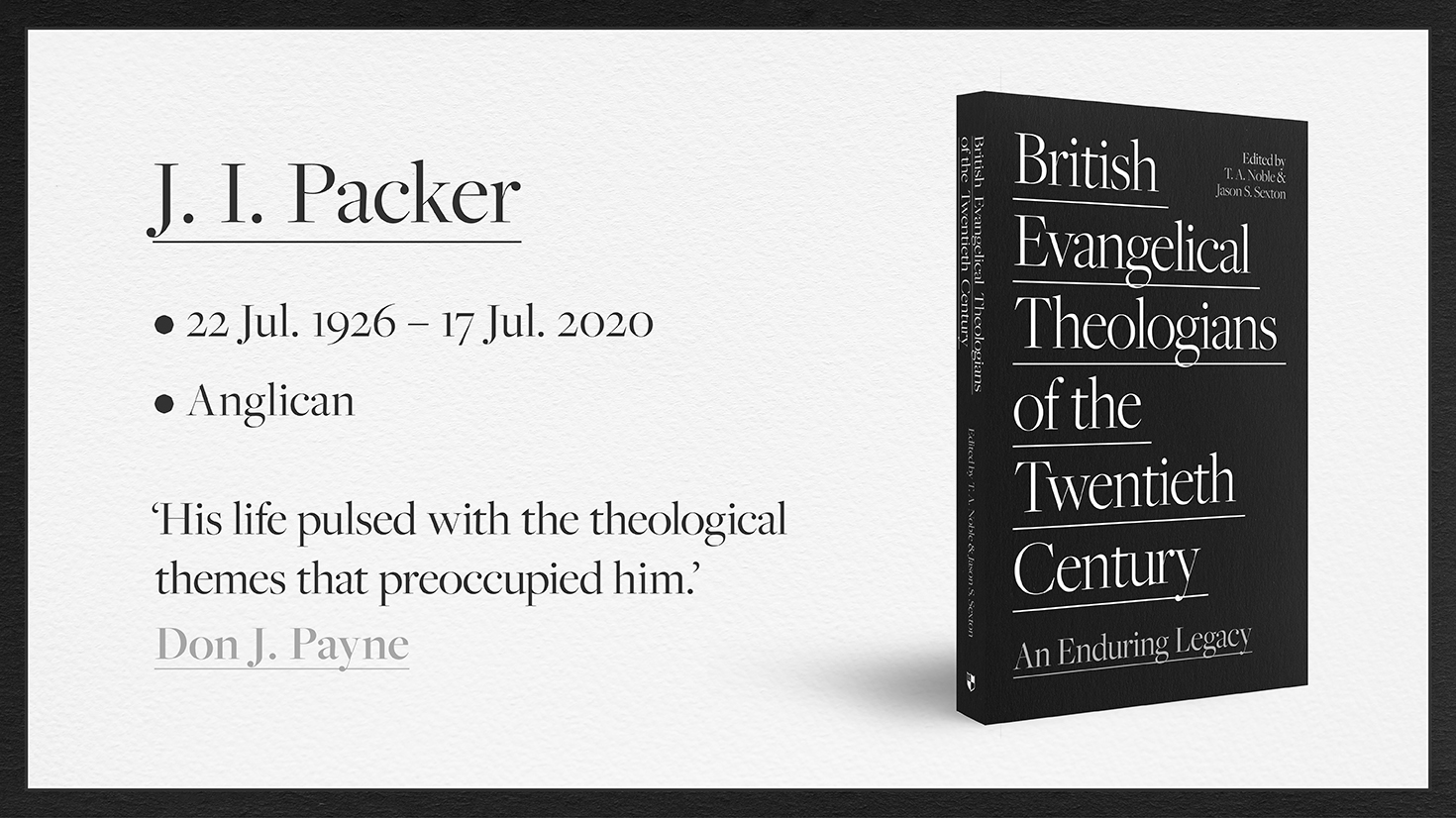
As one of the British Evangelical Theologians from the middle to later part of the Twentieth Century, and with continued influence well into the present, Packer's theological contribtution is well worth reflecting on. Don J Payne's chapter in British Evangelical Theologians of the Twentieth Century, edited by T. A. Noble and Jason S. Sexton, is a good place to start. You can order your copy in paperback or ebook now.
Related Posts

Categories
Recent Posts
4

UK Launch of Called to Care by Jo Knight
28 May 2026
5
May New Releases
18 May 2026
Support IVP with your donation
Either donate with a one-off donation or subscribe monthly.
Choose a type of donation
I want to donate
 I want to donate