



 I want to donate
How can current university culture affect our trust in God?
No matter what culture we are living in, life in a broken world is full of confusion. To make matters even more disorientating, however, our cries of legitimate emotional turmoil are currently sent out into a university culture which thinks that we are, indeed, fundamentally confused. This can easily corrode away our trust in God (especially when we’re under the pressure of personal crisis), so it’s important to understand where our culture is coming from and how it might be influencing our own cries to God.
In order to do so, we need to grapple with the two ideological questions that face every culture. They might seem abstract at first, but they have profound practical implications.
Firstly: how do we know the world?
Secondly: what is out there to be known about it?
The UK in 2020 can be roughly generalised as a predominantly secular culture - and this is certainly practiced in our universities. As a result, this narrative gives us three big statements when it comes to the above questions:
1. The only thing that you can know is the natural, physical world.
2. The only thing that you can know is yourself.
3. The only thing that you can know is the importance of Inclusion.
These three statements are both entirely contradictory (which is puzzling enough in itself!) and have the potential to deeply undermine our trust in our Creator. So let’s consider each in turn and take a closer look at what Acts 17:22-34 might have to say about them.
1. The only thing that you can know is the natural, physical world.
On the one hand, this secular narrative in 2020 tells us that the only thing that we can know for certain is the physical world; stripped of emotion and meaning and the product of random process. What’s more, the only legitimate information that we might amass about this world is quantifiable, ‘scientific’ evidence and data. There is no soul; no self-sacrificial love; no morality beyond cultural convention. Man is at the absolute pinnacle of its existence as a species and is on a steady upward trajectory as a result of natural selection. There is no meaning beyond this relentless process.
2. The only thing that you can know is yourself.
In turn, this emphasis on a meaningless physical world has forced the very real and driving questions of the soul out of the public dialogue and into the personal. Questions like 'Who am I? What should I do? What is the worth my life?’ have all become part of an intensely personal quest for fulfilment. They can’t really be pursued alongside others, because they are both culturally invalidated (since the material world is the only true part of experience) and entirely individual. You want to find meaning? Well, go for it… but there is no meaning out there in the world. If you want to find it, you have to turn inwards and explore yourself.
This fits cleanly with the soullessness of Darwinism and the soul-searching of consumerism (‘if you just buy this L’Oreal product, you’ll finally be the person that you want to be!’). What we are left with is a public dialogue that encourages us to project our emotions and experiences onto reality without restraint. Just like Paul’s ‘People of Athens!’, we are ‘in every way… very religious’ (v22), and the god we end up worshipping is ourselves.
3. The only thing that you can know is the importance of Inclusion.
The key at the centre of these two absolutes is the self that the second statement places so much emphasis on. To look at the self is to realise that we live in relationship to other people, places and things. Both practically and ideologically, we cannot and do not function as isolated individuals in a vacuum. We look inside and find that we are a mix and mess of emotions and relationships; constantly making connections between people, places, ideas, the past, the future, what we want, don’t want, understand, don’t understand…
If we are to live alongside one another as communal, connected creatures with a need for meaning and morality which is larger than the isolated individual, then we require a communal standard to live by - and this must be imposed by something outside of ourselves and outside of own personal, highly individualistic preferences. We need reference points; figures of authority which will guide us; people who understand what we do not yet understand ourselves.
At the moment - as a country with a historic biblical, Christian heritage - the UK still roughly enshrines and adheres to the principle of the importance of tolerance, the dignity of the individual and the principle of ‘loving your neighbour’. Yet the foundation of these principles has disappeared: for we have taken God (and the inherent worth of the individual as made in his image) out of the picture. Why should we love our neighbour? Well, that’s just what good people do...
All the while, our culture is changing in an extremely complex way: its figures of authority redefining its values and its vision of that good. This is centred around the importance of including everyone; creating a space in which all might pursue their individualised vision of what it means to live a good life. This seems beautiful and praise-worthy. Yet such freedom only works until it runs up against another individual’s ability to express themselves. New boundaries must be created as a result of the practical reality of community. Therefore, increasingly, if you don’t love your neighbour in the culturally correct way… you are destined for social exclusion. This suggests that we have defined new moral boundaries. The ‘inclusion’ has become conditional.
But what are the conditions? They are currently relatively unarticulated. We’re expected to know them and to stick to them, without asking questions about where they came from and where they are going. And all the while we’re supposed to love our neighbour… despite the fact that their life is meaningless; we can’t be sure that the external world outside of our head even exists at all; and despite the fact that the main focus of lives should be satisfying those all important (and confusing) selves!
So, what does secularism leave us with?
This leaves us with rather a lot of mixed messages:
1. There is no meaning.
2. It is of central importance that you find personal meaning.
3. You must not encroach on someone else’s ability to explore their own - culturally acceptable - Meaning. If you do, your pursuit of your own meaning will be denied.
One of the major problems with this (aside from it being philosophically and therefore practically inconsistent) is that secularism considers itself to be a neutral Truth, rather than a belief system. This can make being a Christian feel like a slightly subversive and naive add-on, rather than a legitimate and real opportunity to explore what it means to be a human being.
This can feel particularly pronounced when we’re studying the world from a secular viewpoint. If we look back at Acts 17:22-34, our uni lecturers and fellow students often dispute the second half of verse 24, don’t they? ’The God who made the world and everything in it is the Lord of heaven and earth and does not live in temples built by human hands’. Um, yes he does. God and religion are just a construct for people who feel that they need something to worship. All you can know is the physical world, duh. Anything else is an extra choice… and if you have to be weird and believe in something supernatural, then who would want to pick a God who allows so much pain and suffering?
Secular temples
Nonetheless, whether it likes to admit it or not, secular culture has built its own, ideological temples. Statements like ‘I think therefore I am’, ’you do you’ and ‘just do what makes you happy’ all worship both the self and self-submission as a new kind of god; whilst ‘life is meaningless’ and ‘love is an illusion of biology’ worship self-denial. Importantly, however, these statements did not come from nowhere. Whilst they all contain some beautiful truths, they are the product of very specific historical circumstances and bring with them a huge range of assumptions about reality, which don’t necessarily match up with the world and the way that being a human in it actually works. Denying whole facets of reality (like the existence of the soul), does not take the reality of those facets away.
So where does Christianity fit into all this?
The Christian God, meanwhile, addresses the three contradictory statements of secularism under one moral framework and unites the concepts at its base.
1. The self
We are personal creatures, who think, experience and feel; computing life through the lens of our own perception. This is a beautiful thing, because it allows us to have a relationship with God, other human beings and the world that we are in. This relationship relies on aspects of reality which are not quantifiable and easy to put into boxes: like love, trust and hope.
2. The world
We also know that we are personal creatures who think, experience and feel because we were made that way by a personal God, as part of a universe which is much bigger than ourselves. This is a physical reality, in which we live in relationship to God, one another, the physical world and ourselves. Our limited understanding of these things is put into perspective by our relationship as finite human beings to this infinite God. Meanwhile, our own lens does not determine the fundamental character of God or the existence of his world. He is outside of us: knowable, but much bigger than our limited perspective allows us to imagine in his fullness at any one given moment.
3. Love amidst brokenness
Our relationships - with God, the world, one another and ourselves - have been violated and damaged by our sin and selfishness. This means that our lens of self can sometimes feel overwhelming, and we can assert it unfairly onto others, in domination and denial of who God has made them to be. As we interact through our broken selves, we experience turmoil and pain in the face of difficulty, suffering, separation and death, because we know that the world was made for something better: a different and perfect relationship with God. We don’t always understand how to interact or how to act, and this is awkward and confusing.
As we try to navigate this broken world, then, Jesus calls us to love him.
Mark 12:30-31 says that the most important commandment is this: ‘Love the Lord your God with all your heart and with all your soul and with all your mind and with all your strength. The second is this: ‘Love your neighbour as yourself’. This command should liberate us to love one another humbly and selflessly as an acknowledgement of others’ God-given worth and dignity; opening up the possibility of a sustained, committed relationship to and with one another: right here, right now. No-one could ever be too broken to be included in the community. Nonetheless, that doesn’t mean that we can do whatever we like. We have to learn to love one another well, as human beings living in relation to the infinitely holy and loving God. That is a longterm, complicated and liberating process. God assures us that we will mess up, and that’s where we need humility, undeserved kindness and forgiveness.
So, what does Christianity leave us with?
In this way, then, the Bible affirms our existence, the world’s existence, other people’s existence and God’s existence. This is crucial when suffering can feel like it throws everything into a sense of flux.
Whilst secularism tells us that we should be able to find all the answers in our own head (or straightaway from the google search bar), biblical Christianity offers a very different answer. It challenges us to realise that life is bigger than ourselves. We get to know the world, ourselves and God through the process of life; bit by bit and through all kinds of circumstances. This is not easily quantifiable, comfortable, simple or instant. Nonetheless, God promises that he will walk with us through it, working in any and every situation for his (and therefore our) good.
What does this have to do with trust?
From this perspective, life is not a competition for personal expression, but a day-by-day relationship with our Creator based on trust. And though the secular worldview can make us feel as though that trust is unjustified, we need to recognise that it has a strong and unwavering foundation. The Biblical God both makes sense of the practical reality that we are faced with and provides us with redemption in and from it. He stands firm in the face of challenge.
Looking for help in trusting God? We'd love to suggest some resources to help. Take a look at those below, and don't forget to check out the rest of this series!
Related Posts
Categories
Recent Posts
4
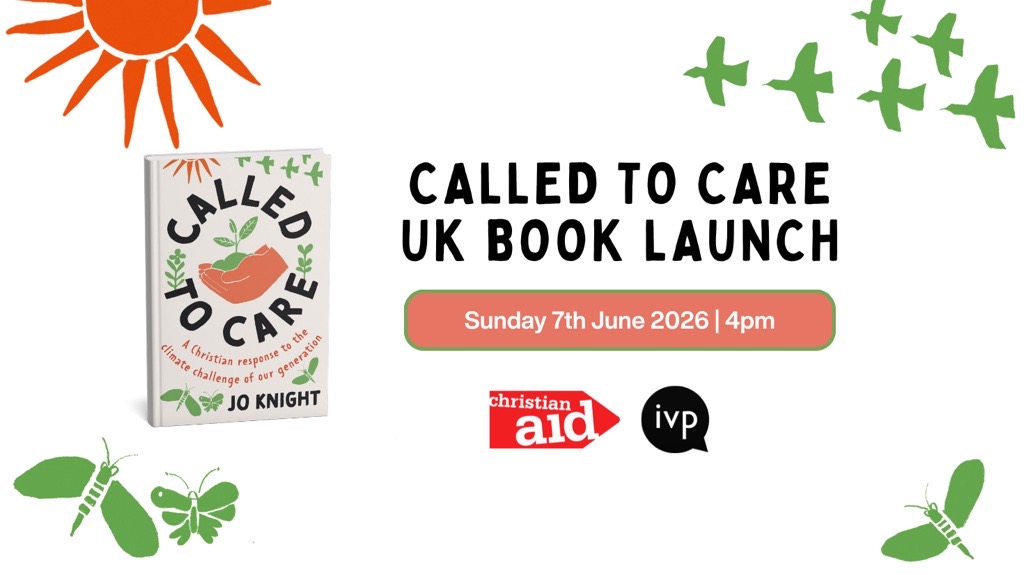
UK Launch of Called to Care by Jo Knight
28 May 2026
5
May New Releases
18 May 2026
Support IVP with your donation
Either donate with a one-off donation or subscribe monthly.
Choose a type of donation
I want to donate
 I want to donate