


 I want to donate
Guest Post: Be All There
- Tom Creedy
- 6 May 2021
-
121views
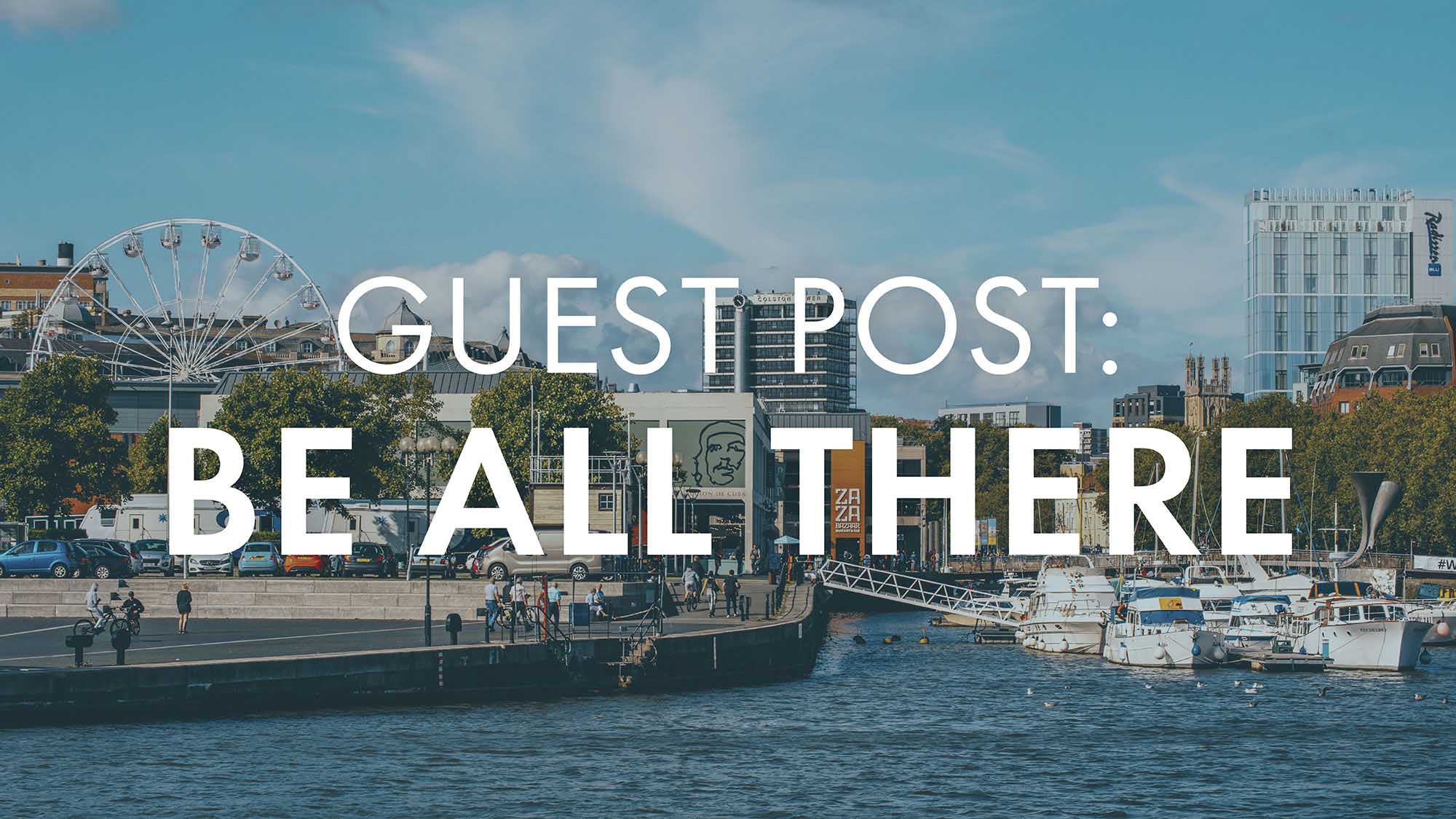
I think I will die in Bristol. Hopefully not soon and preferably not in suspicious circumstances. As a student walking into my dingy halls of residence in 2008, the idea that I would spend any more than a couple of years in this new city that I had never spent more than a day in prior was almost unthinkable. Let’s be clear - it’s not that staying in your university town or city after graduating is particularly novel or unique, but perhaps what was surprising to me was that it didn’t take long for me to realise that Bristol was where I was going to be for decades to come.
Since entering the hovel of halls all those years ago, I have worked as a school teacher in Bristol, become a full-time pastor in a city centre based church in Bristol, got married, had a child and even worked a shift as pizza delivery driver but that’s for another time. That is all to say that the majority of my decisions during and immediately after university were centred around a strong sense of calling to this particular city. In part that has to do with the transient childhood I had and so rooting myself in one place was a response to that. But on a more fundamental level I sensed that God was calling me to this city.
I remember in my first term of university reading Elisabeth Elliot’s “Shadow of the Almighty” and being utterly captivated by the well known quote from her husband “Wherever you are, be all there! Live to the hilt every situation you believe to be the will of God.”
“Wherever you are, be all there!”
To me it was plain and simple. God had led me to this point of being in a new city and I had a decision to make. I could either approach it by keeping my options open, not digging my roots in too deep so that I could make a swift and painless exit if needed. The alternative was get the shovel out. In my mind it was the equivalent of going to the wedding of a friend of your wifes or a distant relative. Either you pay your dues, show your face and leave at the earliest opportunity, or, like I am more accustomed to doing, be the guy that no-one knows, breaking out dance moves the world has never seen and staying until the end to take the uneaten blocks of cheese in a takeaway box. Go hard or go home. Jim Elliot was the guy taking the cheese home. He was all in. And whilst I didn’t hear the call to an Ecuadorian tribe, I was clear that while I was in Bristol, I was going to be all there.
And that’s where it started. This developing story of being called to this city birthed something that was difficult to supplant. I’d been at church services, or large Christian conferences where the call to church planting or overseas mission would be shouted from the rooftops, but all the while having a quiet confidence that I was being called to stay rather than to go. Little did I know that I would be called to stay in order that others might go.
Now as a pastor in Bristol, I often find myself helping people through the questions that many face about their future. It’s a dilemma because firstly, it’s a dilemma because the wrong question is often asked ie. “What is God’s plan for my life?”, but secondly because in an age where commitment is archaic, convictions are unpopular, and the belief that the grass is always greener somewhere else, young people are struggling to make good, wise decisions about their futures.
We need to teach our young people to reframe these big and often overwhelming questions so that they have the best chance of being “all there”, wherever that ends up being.
The first chapter of Ephesians does the hard work for us in this instance. Paul begins this letter by painting the big picture of God’s plans for humanity.
“And he made known to us the mystery of his will according to his good pleasure, which he purposed in Christ, to be put into effect when the times will have reached their fulfillment – to bring all things in heaven and on earth together under one head, even Christ.”
If you’ve ever wondered what God’s plan for your life is, it can be found in the fact that you have been chosen for his good pleasure and that we fit into God’s overall plan which is to bring all things together under Christ. Whilst I believe that we are all made to be unique and therefore by definition will all live different lives, what is unhelpful is the narrative that we have to somehow unearth our unique and mysterious calling that is only reserved for us. From that perspective we become like metal detectorists combing the Sahara Desert hoping to find a Roman coin. What Paul is suggesting in these verses is that rather than being overly concerned about our own calling, we are to see God’s plan which he has made known to us, which is to bring all things under Christ.
Now that may not satisfy your desire to know where your life is heading, but it gives you the flow of the river. We are all heading in the same direction - towards a time when Christ will return in glory and splendour to make a new heavens and a new earth. And as each day goes by, we are a day closer to that wonderful and beautiful reality. But in seeing the flow of the river we can also see the rise and fall of the water, the twists and the turns, the shallow and the deep. God’s plan for humanity is not intended to be uniform nor is it drawn in straight lines. Instead we are invited to experience the flow of the river in all its diversity. We find our current as it were, within the overall flow of the river. God’s plan for your life is that you would discover His great purposes for the universe, and within that cosmic plan, we are invited to play our part.
When I saw this for the first time, it was like someone had removed a strait-jacket from me. I had permission to explore and commit without the fear of somehow missing the hidden treasure of my destiny. An understanding of God’s sovereign and redemptive plans was life giving to me and I realised that in some sense, it didn’t matter where I was in the world, because I could play my part in this incredible story.
But what if I ended up in the wrong place?
What if the job I went for turned out to be a disaster?
What would happen if I put all my eggs in the wrong basket?
How we define success will determine how we navigate those concerns. Our attitude towards the choices we make will define our measures of success. I’ve learnt to take every experience as an opportunity to learn something. In fact the times where I’ve been particularly reckless have been the times where I’ve developed the most. There seems to be a growing trend in our culture that mistakes are somehow irreversible and that we have to protect ourselves and others from making them. In that kind of culture it’s no wonder that young people are scared of committing to something in case they get it wrong. Instead we should be promoting the faith filled lifestyle that may involve mistakes over the picture perfect life that requires flawless decisions.
But perhaps the bigger trap that we fail into is that we believe that God is chiefly concerned about what we do. That the future of our lives is purely based on the decisions that we make, and that God is somehow more pleased with us when we make the right decision and therefore we treat him like a divine search engine hoping to be told the right direction to go in. The truth is that God is far more concerned and far more committed to who you are as opposed to what you do. If you consider what it means to be made in the image of God it speaks to who God has created us to be, rather than what He has created us to do. That for me takes the pressure of making the right decision because our fundamental calling is to be image bearers of God so that when people see us, they understand something of God.
Thirteen years on from moving to Bristol, and amid the mistakes and poor choices at times, the sense that God was calling me to this city long term has remained and I’ve tried to make decisions in line with what I believe God has called me to. It’s been a case of remembering that the world does not revolve around my purpose, nor does all of redemptive history somehow depend on the choices I make. Instead I find myself wrapped up in the will of Christ in whom I find ultimate delight, acceptance and purpose in. But at a deeper level it has been the growing realisation that God’s purpose for me is to transform me into the likeness of His Son and to play my small part in great redemptive story.
To echo a prayer of the puritans:
Help me to know continually
that there can be no true happiness,
no fulfilling of thy purpose for me,
apart from a life lived in and for
the Son of thy love.
We hoped you found that encouraging! Below you'll find some resources to help you dig into Ephesians, and think about God's calling on your own life.
Related Posts
Categories
Recent Posts
3
UK Launch of Called to Care by Jo Knight
28 May 2026
4
May New Releases
18 May 2026
Support IVP with your donation
Either donate with a one-off donation or subscribe monthly.
Choose a type of donation
I want to donate
 I want to donate