

 I want to donate
Enjoying God's Gifts in Creation
- Awareness Days
- 19 Sept 2019
-
180views
In Genesis 1:27-30 we read:
So God created mankind in his own image,
in the image of God he created them;
male and female he created them.
God blessed them and said to them, “Be fruitful and increase in number; fill the earth and subdue it. Rule over the fish in the sea and the birds in the sky and over every living creature that moves on the ground.”
Then God said, “I give you every seed-bearing plant on the face of the whole earth and every tree that has fruit with seed in it. They will be yours for food. And to all the beasts of the earth and all the birds in the sky and all the creatures that move along the ground—everything that has the breath of life in it—I give every green plant for food.” And it was so.
You might have seen a rather strange furore on Twitter over an act of worship involving plants (seriously), but whether or not you did, it is good to be reminded of the good gift of creation that God has given us. Here in Genesis 1 God literally gives humanity plants as food. This is a gift that continues to be ours, even after the fall, and the imagery of plants - whether trees or vines - is integral to many parts of the Bible. In Psalm 104 we read that God "causes the grass to grow for the cattle, And vegetation for the labor of man, So that he may bring forth food from the earth", whilst Jesus famously uses the language of planting seeds to illustrate evangelism in the Parable of the Sower (Matthew 13, Mark 4, Luke 8). There are many more examples! This is because creation is good, and God's gift to us.
In her brilliant book L is for Lifestyle, Ruth Valerio writes:
In Genesis 1:31 we are told that God looked at what he had made and said, ‘It is very good.’ It’s fantastic! This world is amazing! This world is God’s creation, and he loves it. So therefore don’t we also want to love it and look after it? How does God feel when we wipe our ecological footprints all over it and leave it damaged and wrecked? Over the years I have become increasingly convinced just how important God’s creation is to him – not only the human part of his creation, but the whole of it – and that living in a way that takes care of that creation is an absolutely fundamental part of what it means to follow Jesus, as integral to our Christian faith as evangelism and reading the Bible, helping people in poverty and praying. When I look in the Bible, I see four basic reasons as to why that is:
1) Because God loves the world that he has made.
2) Because God has created us to look after the rest of his creation.
3) Because the world has gone wrong because of us.
4) Because God has a future for this world.
Our relationship with the rest of creation finds its centre in the coming of Jesus to live on earth as a human being, to die and be raised to life again. God’s plan finds its fulfilment in Jesus, who affirms creation by choosing to become a part of that creation, and, by dying and being raised to life again and ascending into heaven with his resurrected body, brings potential healing to every broken relationship (Romans 8:19–22; 2 Corinthians 5:18–21; Ephesians 2:11–18). It is crucial
to understand that God’s intention for salvation involves the whole of creation, not just humanity alone (see also Colossians 1:15–20).
The Bible ends with a wonderful picture of the renewed heaven and the renewed earth (Revelation 21 – 22). This picture describes how the world that God has made as the new Jerusalem comes down from heaven – we do not ‘go up there’. All things are made anew in Jesus, involving all creation, as the tree of life bears its fruit for all humanity to enjoy and the curse of the fall is finally ended. In a manner similar to our own resurrected bodies, there is both discontinuity (seen in 2 Peter 3:3–16) and continuity (seen in Romans 8:18–30) between the present and the new heaven and earth.3 The emphasis of the word ‘new’ is on transformation rather than destruction, indicating ‘newness in terms of quality rather than of something new that has never been in existence’. In this way, as Richard Bauckham and Trevor Hart say, we understand ‘the new creation itself not as a replacement for the present world, but as the eschatological [relating to end times] future of this world’.
You might be thinking 'brilliant! Plants are obviously part of God's goodness to us in creation, and all this talk of the renewed heaven and renewed earth is deeply encouraging. But what can I do about it now?
Fortunately, Ruth's got some helpful suggestions, and after those, there are a few other books you might find helpful for thinking through this topic.
So what does that mean for us?
First, we need to be learning about the major threats to God’s creation: issues such as climate change, deforestation, the loss of species and biodiversity, consumer waste and pollution. We shall be exploring all of these and more in later chapters. Second, we can then begin to consider what we can do in our own lives to start making a difference. When looking at such huge problems, it can be helpful to see ourselves standing within concentric circles, each circle representing a wider area for involvement. These areas are: ourselves, our church, our local community, our country and our world.
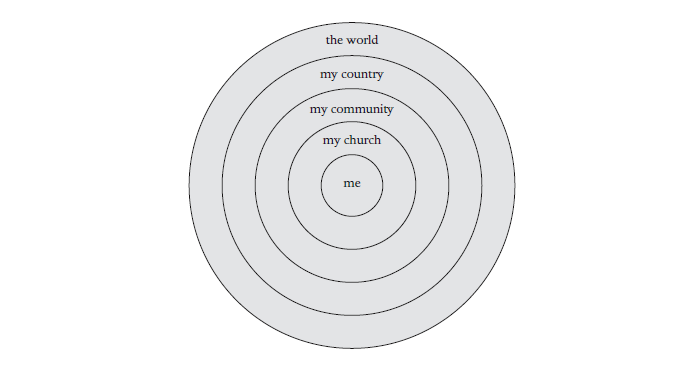
So, for example, we can change some of the everyday things we do, perhaps increasing what we recycle, or reducing our car usage. In our churches the best thing we can do is take a look at Eco Church, which will give us all the tips and help we need. In our local communities there may be a conservation organization or environmental group we could join. Perhaps we could encourage our local authorities to improve recycling facilities. When we move on to our country and world, we begin to enter the area of campaigning. Here it is useful to belong to a national or international organization that will help us. (We will look more closely at these issues in later chapters.) What we have to remember is that we cannot do everything.
But that is no reason to do nothing! While each little action we take is only a drop in the ocean, together those drops will make a difference. Not only is this our responsibility; it is a part of the essence of being people created by God that we care for the rest of what he has created.
Action point
• Fall in love with the world around you. Stop to smell a flower, notice a particular colour, watch a bird fly, follow the seasons in your garden . . .

If you'd like to dig deeper into what the Bible has to say about our relationship with creation, then here at IVP we've few books to get you started:
Related Posts
Categories
Recent Posts
4
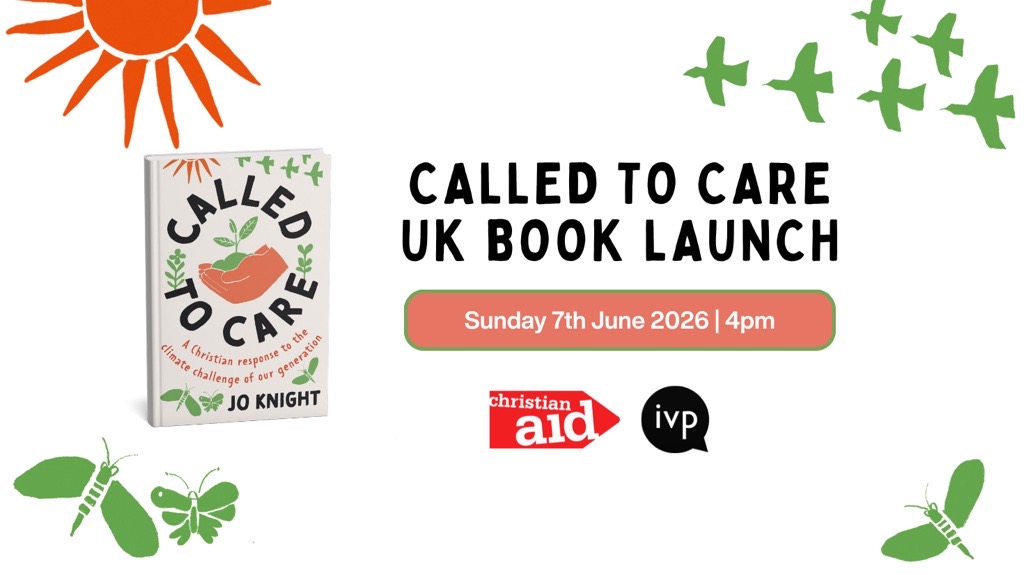
UK Launch of Called to Care by Jo Knight
28 May 2026
5
May New Releases
18 May 2026
Support IVP with your donation
Either donate with a one-off donation or subscribe monthly.
Choose a type of donation
I want to donate
 I want to donate