




 I want to donate
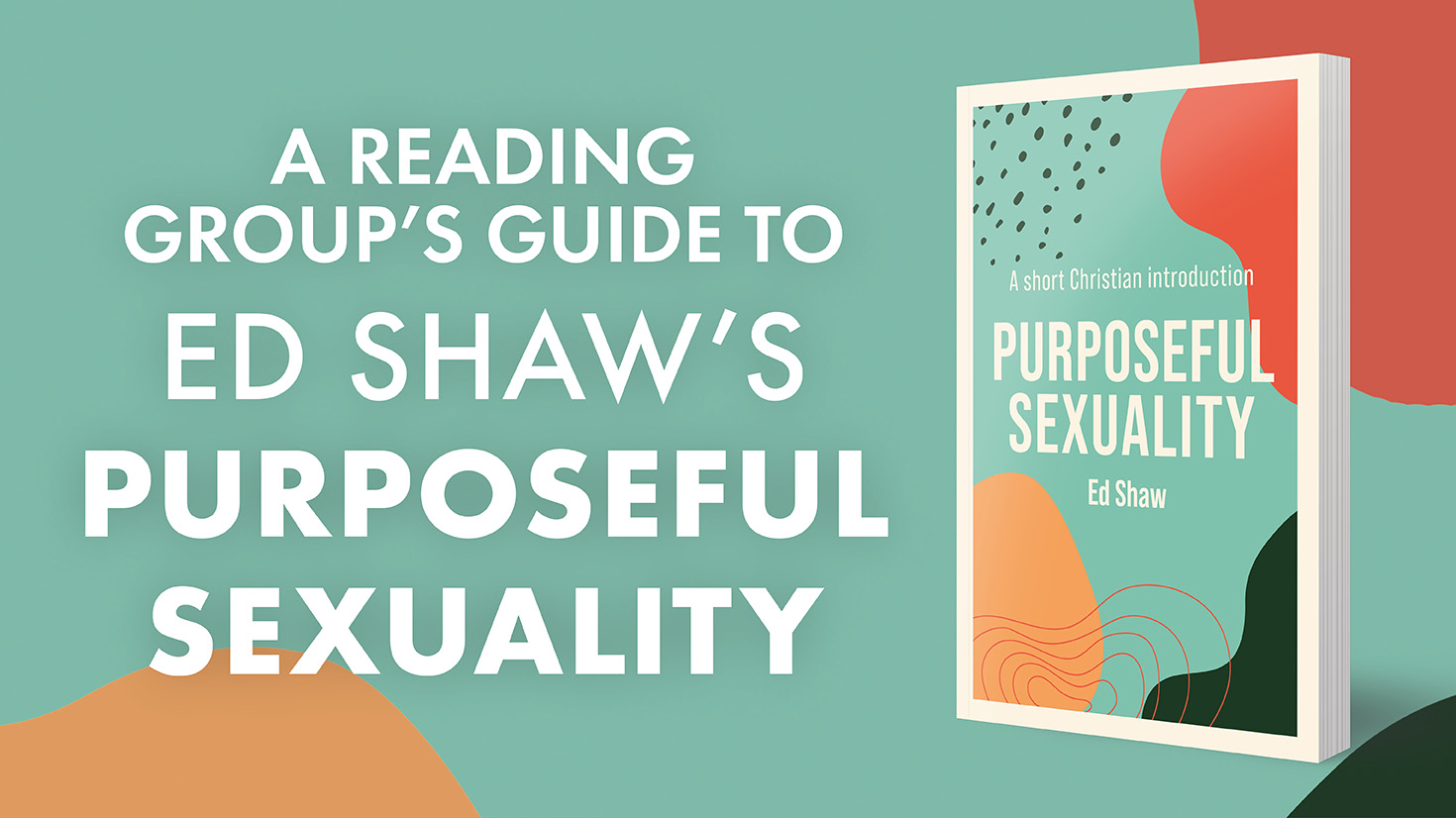
A Reading Group's Guide to: Ed Shaw's Purposeful Sexuality
- General
- 26 Aug 2024
-
263views
A Reading Group's Guide to: Ed Shaw's Purposeful Sexuality
As a student at an Art School, I often come face to face with issues and questions about sexuality. Finding that these are broad and varied, I have found it difficult to remain Biblical and sensitive when dealing with issues that seem to constantly change. However, I found this book extremely helpful for this, being small in volume yet big in meaning.
In this book, Ed Shaw clearly and sensitively deals with the core question of ‘What is our sexuality for, and how can we live this out?’ Underpinning all of his points are expositional references to the Bible, carefully combined with personal experiences, and stories of others’ experiences and viewpoints. I found it particularly helpful that the book has a very clear and logical point to make, and that all of the chapters seek to work together to explain a core issue, which then helps us to tackle present issues that come up in everyday life.
A key point that Ed seems to be focused on is that God has created sexuality to be an image, a ‘trailer’ for our relationship with God, as we will fully experience it in heaven. As a student, I found this extremely helpful. I have found that, at Uni, and particularly in the art world, issues around sexuality are constantly changing, and therefore there seem to be constant new questions to think through. However, understanding the core reason for our sexuality is extremely helpful, since this then helps us to tackle all of these issues, since it applies to them all. I also find that, if we do not understand why biblical teaching on sex is good news, it is very difficult to answer questions that our Christian and non-Christian friends ask, and, ultimately, makes the gospel less appealing to both them and us.
I deeply recommend reading this book for that reason and think that it would be particularly helpful to be read as a group. Therefore, in this post, I’ve put together a few questions to think through as you read each chapter, as well as a one-sentence summary for those who, perhaps, accidentally miss a chapter or (like me) read the chapter but soon forget what it was about. Since this book is mainly directed at those who are Christians, that is, those who have put their faith in Christ and are seeking to live this out, I would recommend this being read in those circles, rather than used as an evangelistic book (though if you are reading this and are not trusting in Jesus, I would recommend this book to you also). I haven’t included this in the questions, but, as you read the book together, I suggest that you pray together at the beginning and end of your discussions (it’s all about God so it’s important to discuss it with him too!). All of the references in this blog post are taken from the Bible, or Ed Shaw’s book. (Ed Shaw, Purposeful Sexuality, 2020)
Introduction and Chapter 1
In chapter one, Ed Shaw speaks about what ‘sexuality’ is, why we need to talk about it, and why it is so difficult to talk about. Critically, he focusses on the fact that we all have a unique sexuality, that it is ‘damaged’ and has ‘damaged’ others.
‘We carry around emotional
scars, perhaps even huge gaping wounds, from what was done
to us in the past…It injects so much pain into
the discussion, and perhaps reignites feelings of shame that
we hoped had died away.’
‘Perhaps most of us have been quietly damaging others
in smaller ways that have gone unnoticed by others, and
perhaps unrepented of by us.’
-what is your personal reason for wanting to read this book?
-what is your experience of talking about the topic of sexuality?
In chapter one, Ed Shaw speaks about how in the theme of sexuality, we have all been damaged by others, and have damaged others.
Chapter one mentions Gen 1-3.
Read this as a group, and discuss what it teaches us about ourselves and our desires. What does it teach us about the part we have to play in the ‘damage’ of the world? (victims, perpetrators, something ese etc.?)
What hope does this chapter bring us on this subject?
Chapter 2
This chapter begins to tackle head on the core question of ‘what is sexuality for?. Ed circles towards the question, mentioning three good reasons, then mentions that these are all good reasons, but not the core reason.
-What has your experience been of talking about sex, in Christian and non-christian conversations?
-What, up until now, were you taught sex was ‘for’?
The three reasons he mentions are ‘Marital union’, ‘Having children’, and ‘Sharing pleasure’.
-Which of these have you heard before?
-Do you agree that these are some of the things that sexuality is ‘for’?
-Do you think this misses anything out?
Ed mentions that these are not the core reason.
‘To answer the key question ‘What
is sexuality for?’ with just these answers – however good and
true they are – is to set everyone up for a fall, because these
answers are not the whole truth. They are not good enough
in and of themselves. God has so much more to say on the
subject.’
-What do you think is the core reason?
-How is what you have already heard from Ed contrary to what you/others would say sex is ‘for’?
-How can this change and bring hope to those views?
Chapter 3
In this chapter, Ed makes two main points. Sexuality points us to how strongly God loves us, and marriage is a symbol of our relationship with God, a ‘dress rehearsal’.
“Then the angel said to me, ‘Write this: Blessed are
those who are invited to the wedding supper of the
Lamb!’ And he added, ‘These are the true words of
God.’”
(Revelation 19:6–9)
-Before reading this book, what did you think marriage was ‘for’? What do you think of the reason Ed presents in this chapter?
-How do you feel about Christ calling us his ‘bride’? How does that change how you see yourself? How does that change the way you see other Christians?
‘We have sexuality, sexual experiences and feelings so
that we can grasp God’s love for us and to point us to
where this world is heading.’
-What do you think of Ed’s point that sexuality is given to us, so we can understand God’s strong love for us?
-How does this change the way we view our own sexuality?
Chapter 4
In this chapter, Ed focuses on the fact that, in order to reflect the picture of Christ and the church, two people in a sexual relationship must be bodily different; a man and a woman.
-What has been your past experience of Christian teaching on homosexual sex?
-What were the reasons you were given for those views?
‘It turns out that sexual difference is important both theologically
and experientially if sex is to be properly understood
and enjoyed’
What do you think of Ed’s point that in order for the ‘trailer’ to successfully depict the ‘film’ the two bodies must be different?
What difference does this core reason for sex make to Ed’s claim that homosexual sex is wrong?
Ed then makes the point that beauty in others is a reflection of the beauty of God.
‘We need to appreciate, increasingly, that any time we’re
instinctively attracted to another human being is a call to
worship – a call to worship the Creator of the beauty, not the
bearer of it.’
What difference does this make to times when we feel attraction to other people?
How can you personally commit to remembering that the beauty of others is a call to worship God?
Chapter 5
In this chapter, Ed comments on the fact that we live in a society that arguably worships sex (or 'love', which can so often be misunderstood), claiming that to miss out on sex is to miss out on happiness. Ed makes the point that, if sex is simply a trailer to our final everlasting relationship with God, missing out on sex means missing out on only the trailer, not true happiness and fulfillment.
‘Contrary to the world’s narrative, we are not missing
out on the real thing that makes life worth living, just an
imitation designed to point us to where the real thing is to
be found.’
-In your social circles, what is the general attitude towards those who are single, or are not in a sexual relationship?
-How does seeing sex as a ‘trailer’ change this view?
-How is this view of sex good news for our friends, family, and ourselves? (both Christians and non-Christians alike)
Next Ed focuses on sexual temptation. His main point seems to be that this is a spiritual battle. Because our bodies are temples, it is important that we honour God with them, and therefore, the devil will tempt us into sexual immorality. He quotes Paul, who says:
‘Flee from sexual immorality. All other sins a person
commits are outside the body, but whoever sins sexually,
sins against their own body. Do you not know
that your bodies are temples of the Holy Spirit, who is
in you, whom you have received from God? You are
not your own; you were bought at a price. Therefore
honour God with your bodies.’
(1 Corinthians 6:18–20)
How does this help us to realise how important it is to ‘flee from sexual immorality’? How does the fact the our ‘bodies are temples of the Holy Spirit’ give us hope in our fight against temptation?
Chapter 6
Here, Ed focuses on the fact that Jesus was a man, and so would have experienced sexual attraction, yet remained celibate his whole life, and therefore understands the temptations that we face. He explains how the story of the woman at the well is an example of this.
Do you find it surprising/ shocking that Jesus experienced sexual temptation? Why?
What has been your teaching in the past on ‘the woman at the well’?
Have you ever heard this interpretation before? How does it change the way that we read it?
-If Jesus understands what sexual temptation is like, what difference does that make to us, as we seek to live sexually pure lives?
Ed then says that Jesus, having lived a perfect sexual life, is good news for our sexual history. This is because, on the cross, he took our sexual sins, and gave us his perfect sexual history in return.
How does this make a difference to the way we see our sexual history and the sexual history of Christians around us?
Lastly, Ed makes the point that the starting point for purposeful sexuality, and the reason it can be achieved is because God helps us to achieve it.
What difference does it make to our spiritual battle if Jesus is helping us to fight it?
_____________________________________________________________
I hope these questions have been helpful. As you come to the end of the book, I suggest that you pray together as a group, discussing how this makes a difference to Christians and non-Christians in your own social circles, and to each of you in particular. Perhaps you could pray for; your own sexual lives, the issue of sexuality in the church, those in your Uni who aren’t Christians, and Christians you know who aren’t living sexually in the way that the Bible tells us too, who need to hear the good news of the gospel, which allows us to live sexual lives in the way God intended.
Related Posts

Related Products
The Plausibility Problem
From £9.99

A Better Story
From £13.99

Purposeful Sexuality
From £8.99
Finding Your Best Identity
From £8.99
Categories
Recent Posts
4

UK Launch of Called to Care by Jo Knight
28 May 2026
5
May New Releases
18 May 2026
Support IVP with your donation
Either donate with a one-off donation or subscribe monthly.
Choose a type of donation
I want to donate
 I want to donate