





 I want to donate
A God of Amazing Restoration: Hope for Those Who Think They’ve Gone Too Far
- Rochelle Owusu-Antwi
- Blog
- 24 Oct 2025
-
228views
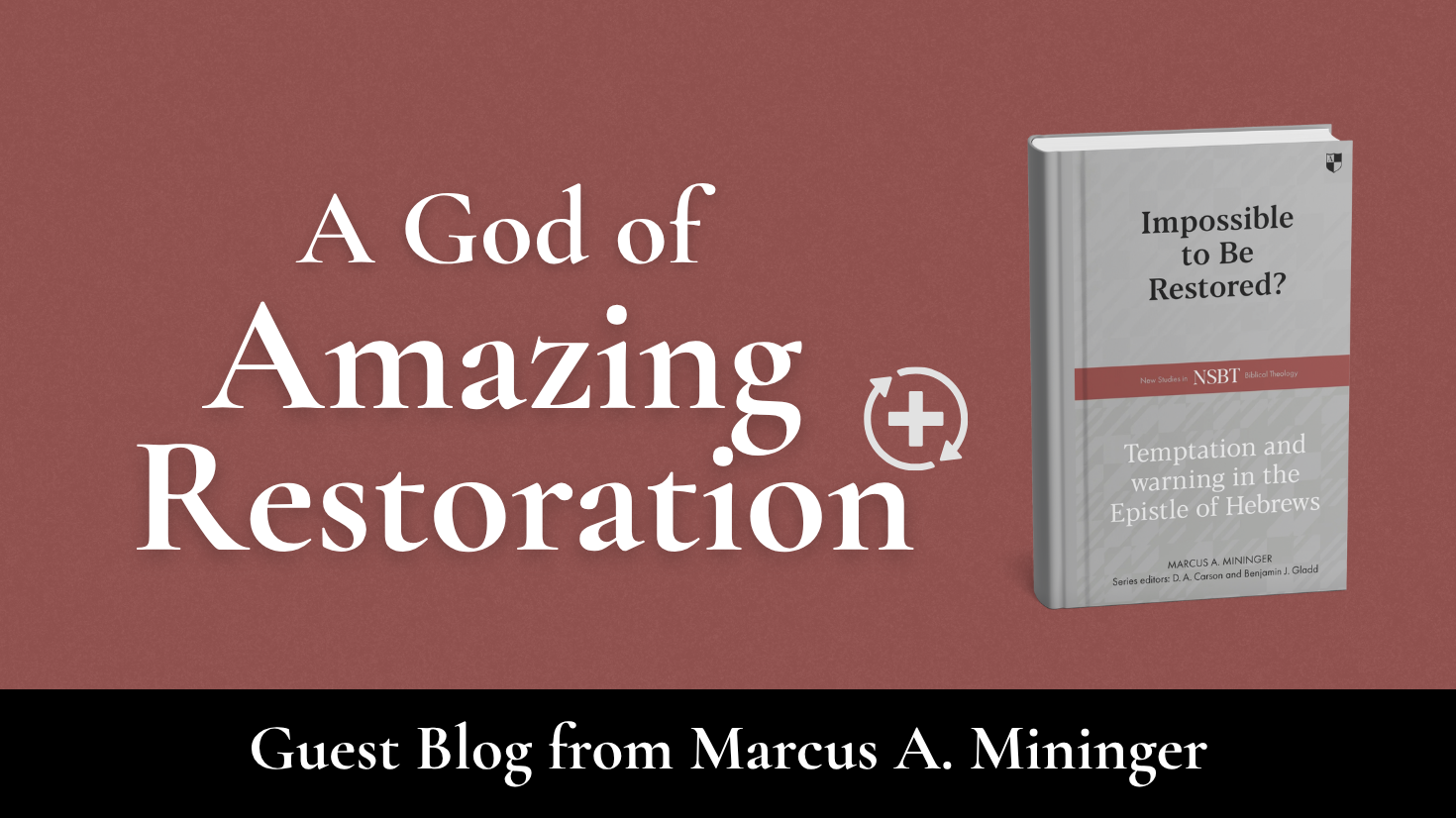
A God of Amazing Restoration
Guest Blog Post by Marcus A. Mininger
In this guest post, Marcus A. Mininger, author of Impossible to Be Restored?, reflects on the tension between the Bible’s warnings and its message of grace. Drawing on the letter to the Hebrews, he explores what it means that God restores, forgives, and renews, even when we fear we’ve gone too far. Through Scripture’s realism about sin and its hope-filled picture of repentance, Marcus points us to a God of astounding mercy and restoration.
Many people experience great burden over their sins and fear that God could not possibly forgive them or restore them into right relation with himself. Sometimes they feel this way regarding themselves. Other times they feel this concern for others that they know and love. Have we or they gone too far, past the possibility of return, past the reach of God’s willingness to receive us back?
If we look at how other people—perhaps especially other Christians—respond to sin, our fear and sense of despair may increase. We live in a world that loves to express scorn and indignation, to reject others for their sins or failings. Social factors like these can easily color our view of God as well.
Thankfully, though, Scripture encourages us again and again about the astonishing abundance of God’s willingness and ability to restore contrite sinners who turn or return to him. This ability and willingness is something that he has ultimately expressed in the richly sufficient work of Christ as sacrifice for sin and constant mediator. As the apostle Paul says, where sin has abounded, grace has superabounded (Rom 5:20).
Sin is no trifle. It is dark and enslaving and heinous. But as bad as it is, God’s powerful grace is even greater, and he richly provides it to those who turn from sin—for the first time or afresh—with faith in a sufficient Savior. Though other people’s responses and the thoughts of our own hearts may promote despair, Scripture is filled with reasons for hope.
Really, the whole flow of the Old Testament helps encourage us that God restores wayward and fallen sinners. God made Israel his own people, blessed them abundantly, and put his name upon them. But again and again they stray, even grievously. And yet again and again and again, God not only exposes their sin and calls them to turn from it but promises and provides rich, abundant, restorative grace. Even when they were in exile, experiencing the shame of their waywardness, God not only spoke oracles condemning their sin, he also sent prophet after prophet to promise new hope, which would ultimately come in Christ. Truly, God’s track record with Israel is astonishing, showing the extent of his commitment to restorative grace.
Thankfully, this pattern of restoration applied to individuals in the Old Testament too. We can think especially of David, whose dramatic fall into gross, destructive sins brought the Lord’s hand of discipline upon him, but who was also restored and confirmed in his salvation (Psa 51).
Likewise in the New Testament period, none other than the apostle Peter denied Christ publicly and emphatically three times, falling into disgrace. And yet three times Christ pronounced restoration, as Peter again professed his own love (John 21:15-17). And the story of the Prodigal Son (Luke 15) provides such a vivid image, where the father runs out to receive the son who had shamed him and defiled himself, yet eventually returned. Following this same pattern, then, the apostle Paul urges the Corinthians to receive back and restore a fallen Christian (2 Cor 2:5-7). He also describes Christians leaders who have fallen away and then prays that God may still grant the wayward repentance unto life, releasing them from the Devil’s snare (2 Tim 2:17, 25-26).
Yet despite the consistency of Scripture’s teaching about God’s gracious call to apostates to return to him, some have thought that the Epistle of Hebrews teaches the opposite. Perhaps—they suggest—the standard of the new covenant is stricter on this topic, and they appeal to warning passages such as Heb 6:4-6. Of course, the language in that passage is quite strong, saying that in some way or another it is impossible for a person who has experienced various blessings of the new covenant and fallen away to be restored. Yet what exactly does this mean? Does it teach a kind of “one and done” view of salvation, where each person only gets one chance in the covenant, and if they fall away they cannot return to Christ or the church?
Thankfully, the simple answer is, no. That interpretation is a misunderstanding of the original context of Hebrews. Despite what some have thought, the message of Hebrews about apostasy actually fits into the clear pattern seen throughout the rest of Scripture, and my book Impossible to Be Restored? provides new evidence to explain how this is so.
To see that, it is important, first, to understand the exact context of the original audience of Hebrews. Though recently some have denied this, the evidence in the Hebrews shows that its audience was tempted to depart from their Christian faith and attempt to start all over again under the provisions of the old covenant alone (Heb 6:1-2). Most likely, their motivation for this was to avoid persecution by blending in more with the non-Christian Jewish community that Rome gave more tolerance.
Against the background of that context, the warning passages in Hebrews are very relevant. They are not stating that if someone departs from the Christian faith they can never come back to Christ and be forgiven. They are instead stating that if someone departs from the Christian faith they cannot return and find right-standing with God under the old covenant alone. And this is not because the old covenant was bad or lacking in grace. It is because the old covenant was designed from the outset to lead toward and be fulfilled by the work of Christ in the new covenant (Heb 9:23-24). As a result, now that Christ has come, shrinking back from him and seeking to hold onto the old covenant by itself would destroy the very purpose of the old and is therefore simply impossible to do (6:4-6).
Far from simply wanting to warn new covenant Christians about a misunderstanding and misuse of the old covenant, though, Hebrews is much more concerned to emphasize and provide reassurance about the greatness, permanence, and sufficiency of Christ’s own work and to call people to renewed faith and assurance in him. Christ is a sympathetic high priest, who has been made like us in every way, yet without sin (Heb 4:15). He has offered an ultimate, once-for-all sacrifice for sins (10:12-14). And he has gone before us into heaven, where he ever lives to intercede for us (7:25). In these ways, the real emphasis of Hebrews is right where we find it in the rest of Scripture, upon the abundance of God’s grace to restore and save sinners.
As we look throughout the pages of the Bible, then, we see sin treated very seriously, not glossed over or downplayed. But we see God’s grace to restore penitent sinners who are contrite in heart even more. Thanks be to God who encourages us to confess our sin and turn to him, whether for the first time or afresh, with expectation of being restored in and through the mercy and mediation of his perfect Son, Jesus Christ!
Related Posts
Related Products
Impossible to be Restored?
From £20.00
Categories
Recent Posts
3

IVP Authors at Keswick Convention 2026
18 Jul 2026
Support IVP with your donation
Either donate with a one-off donation or subscribe monthly.
Choose a type of donation
I want to donate
 I want to donate