

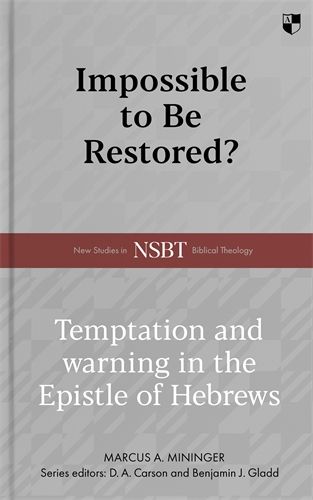
Impossible to be Restored?
Temptation and Warning in the Epistle of Hebrews
A focused and clear study of the themes of temptation and warning in the Epistle to the Hebrews, new in the NSBT series.
In stock
ISBN-13
9781789745795-grouped
From £20.00
"Impossible to be Restored? adds further lustre to the already fine series of New Studies in Biblical Theology. Marcus Mininger suggests a solution to some of the puzzles in Hebrews by following the clues that lead us into the sitz im leben of its first hearers. By doing so he provides a coherent interpretation of its warning passages. The result is a study that functions at several different levels. To the scholar it offers a careful and stimulating study that serves to loosen an exegetical knot with which theologians have struggled for centuries. And, not least, to pastors, preachers, and counsellors it provides biblical exposition that will inform their preaching and their ability to give a helpful reading of Scripture not least to troubled souls."
"Marcus Mininger carefully analyses Hebrews' warning about the impossibility of repentance for apostates (Hebrews 6:4). After thoroughly reviewing diverse scholarly opinions, he reformulates a traditional reading of Hebrews' situation. The epistle warns its addressees not to avoid persecution by reverting to Jewish practices, the "foundation" of faith (Hebrews 6:1). Reconciliation to Christ remains possible for serious sinners; retracing the initial path to him through the old covenant is not. A thoughtful exploration of pastoral implications concludes his treatment. Anyone interested in a central theological "crux" of Hebrews will welcome this research."
"I commend this book for setting forth what in my opinion is a definitive advance in understanding the apostasy passages in the book of Hebrews, with special focus on Hebrews 6:-16. It resolves by careful exegesis the difficulties belonging to a most vexing and disputed passage. Moreover, it has practical implications for how theologians think about apostasy and how the church should deal with people who have abandoned the faith or are contemplating it. The book underlines vigorously the fact that Christ is the only way of salvation, thus also providing resources for answering the modern attempts to find an opening for salvation through other religions."
"A person with a fresh perspective poses questions that have ceased to be asked. This fresh inquiry is what Mininger has brought to the study of Hebrews. The questions he poses are fresh, but not naive. He has devoted years of scholarly investigation to find suitable answers for some of the most difficult sections of this powerful letter. Insightful, thorough, gracious and pastoral, Impossible to Be Restored? should become a necessary conversation partner for all those interested in the background, text and impact of the Epistle to the Hebrews."
"Mininger's arguments are impressive. He well argues that the letter is addressed to those primarily influenced by Judaism, to which I agree. Although this is not an unusual conclusion, his argumentation for it, including a fair explanation of those who disagree, is excellent. Beyond this, Mininger's primary burden is to solve many of the difficulties with Hebrews 6:1-6. His solution is that the "impossible to restore again to repentance" text refers to the impossibility to return to the Old Covenant for redemptive-historical reasons. This conclusion needs to be considered seriously by the scholarly world, and more especially, the evangelical world. Although in the end, I disagree with Mininger on this, I am whole heartedly in favour of this view being included as one of the standard views on Hebrews 6."
"Here is a carefully argued and clearly articulated approach to solving some of the stickier interpretative issues in Hebrews. Mininger offers fresh insights into Hebrews in light of its place in redemptive history, and helps us consider how this letter continues to speak to us today."
"In this thorough study of Hebrews' warning against apostasy, Marcus Mininger effectively exposes the shortcomings of existing interpretive approaches before offering a fresh and convincing reading that has been hiding in plain sight. His redemptive-historical interpretation, focusing on the impossibility of returning from the new covenant to the old covenant alone, aligns seamlessly with both the letter's theological argument and the broader biblical witness."
About
The letter to the Hebrews contains and engages with some of the most perplexing passages of Scripture. Temptation and apostasy provide one way of reading this New Testament book.
This volume in the New Studies in Biblical Theology series examines the Letter to the Hebrews, what temptation its audience was facing, and what Hebrews meant when it warned that some who fall away cannot be restored to repentance.
Marcus A. Mininger addresses questions such as:
- Is the sin of apostasy unforgiveable?
- Are apostate Christians unable to return to Christ ever again and to his church?
Setting the letter in the context of scholarly debate, Mininger addresses these contested issues in a fresh way, while also demonstrating the cohesive nature of the Epistle in relation to key biblical-theological themes.
Deeply exegetical, sensitive to wider themes, and rigorously engaged with scholarly literature, Impossible to be Restored? also shows the ongoing relevance of the Letter to the Hebrews for the challenges facing the church today, both internally and externally.
This is a volume in the New Studies in Biblical Theology. The NSBT is a series of monographs that address key issues in the discipline of biblical theology.
This volume in the New Studies in Biblical Theology series examines the Letter to the Hebrews, what temptation its audience was facing, and what Hebrews meant when it warned that some who fall away cannot be restored to repentance.
Marcus A. Mininger addresses questions such as:
- Is the sin of apostasy unforgiveable?
- Are apostate Christians unable to return to Christ ever again and to his church?
Setting the letter in the context of scholarly debate, Mininger addresses these contested issues in a fresh way, while also demonstrating the cohesive nature of the Epistle in relation to key biblical-theological themes.
Deeply exegetical, sensitive to wider themes, and rigorously engaged with scholarly literature, Impossible to be Restored? also shows the ongoing relevance of the Letter to the Hebrews for the challenges facing the church today, both internally and externally.
This is a volume in the New Studies in Biblical Theology. The NSBT is a series of monographs that address key issues in the discipline of biblical theology.
From the Blog
Reviews
"Impossible to be Restored? adds further lustre to the already fine series of New Studies in Biblical Theology. Marcus Mininger suggests a solution to some of the puzzles in Hebrews by following the clues that lead us into the sitz im leben of its first hearers. By doing so he provides a coherent interpretation of its warning passages. The result is a study that functions at several different levels. To the scholar it offers a careful and stimulating study that serves to loosen an exegetical knot with which theologians have struggled for centuries. And, not least, to pastors, preachers, and counsellors it provides biblical exposition that will inform their preaching and their ability to give a helpful reading of Scripture not least to troubled souls."
"Marcus Mininger carefully analyses Hebrews' warning about the impossibility of repentance for apostates (Hebrews 6:4). After thoroughly reviewing diverse scholarly opinions, he reformulates a traditional reading of Hebrews' situation. The epistle warns its addressees not to avoid persecution by reverting to Jewish practices, the "foundation" of faith (Hebrews 6:1). Reconciliation to Christ remains possible for serious sinners; retracing the initial path to him through the old covenant is not. A thoughtful exploration of pastoral implications concludes his treatment. Anyone interested in a central theological "crux" of Hebrews will welcome this research."
"I commend this book for setting forth what in my opinion is a definitive advance in understanding the apostasy passages in the book of Hebrews, with special focus on Hebrews 6:-16. It resolves by careful exegesis the difficulties belonging to a most vexing and disputed passage. Moreover, it has practical implications for how theologians think about apostasy and how the church should deal with people who have abandoned the faith or are contemplating it. The book underlines vigorously the fact that Christ is the only way of salvation, thus also providing resources for answering the modern attempts to find an opening for salvation through other religions."
"A person with a fresh perspective poses questions that have ceased to be asked. This fresh inquiry is what Mininger has brought to the study of Hebrews. The questions he poses are fresh, but not naive. He has devoted years of scholarly investigation to find suitable answers for some of the most difficult sections of this powerful letter. Insightful, thorough, gracious and pastoral, Impossible to Be Restored? should become a necessary conversation partner for all those interested in the background, text and impact of the Epistle to the Hebrews."
"Mininger's arguments are impressive. He well argues that the letter is addressed to those primarily influenced by Judaism, to which I agree. Although this is not an unusual conclusion, his argumentation for it, including a fair explanation of those who disagree, is excellent. Beyond this, Mininger's primary burden is to solve many of the difficulties with Hebrews 6:1-6. His solution is that the "impossible to restore again to repentance" text refers to the impossibility to return to the Old Covenant for redemptive-historical reasons. This conclusion needs to be considered seriously by the scholarly world, and more especially, the evangelical world. Although in the end, I disagree with Mininger on this, I am whole heartedly in favour of this view being included as one of the standard views on Hebrews 6."
"Here is a carefully argued and clearly articulated approach to solving some of the stickier interpretative issues in Hebrews. Mininger offers fresh insights into Hebrews in light of its place in redemptive history, and helps us consider how this letter continues to speak to us today."
"In this thorough study of Hebrews' warning against apostasy, Marcus Mininger effectively exposes the shortcomings of existing interpretive approaches before offering a fresh and convincing reading that has been hiding in plain sight. His redemptive-historical interpretation, focusing on the impossibility of returning from the new covenant to the old covenant alone, aligns seamlessly with both the letter's theological argument and the broader biblical witness."





This volume in the New Studies in Biblical Theology series examines the Letter to the Hebrews, what temptation its audience was facing, and what Hebrews meant when it warned that some who fall away cannot be restored to repentance.
Marcus A. Mininger addresses questions such as:
- Is the sin of apostasy unforgiveable?
- Are apostate Christians unable to return to Christ ever again and to his church?
Setting the letter in the context of scholarly debate, Mininger addresses these contested issues in a fresh way, while also demonstrating the cohesive nature of the Epistle in relation to key biblical-theological themes.
Deeply exegetical, sensitive to wider themes, and rigorously engaged with scholarly literature, Impossible to be Restored? also shows the ongoing relevance of the Letter to the Hebrews for the challenges facing the church today, both internally and externally.
This is a volume in the New Studies in Biblical Theology. The NSBT is a series of monographs that address key issues in the discipline of biblical theology.