

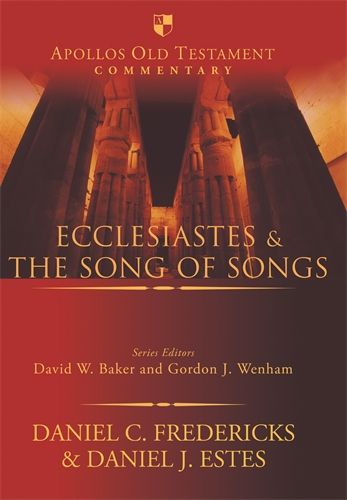
Ecclesiastes & the Song of Songs
Explore the profound connections between Ecclesiastes and the Old and New Testaments. Discover how Hebrew voices illuminate timeless wisdom and teachings.
In stock
ISBN-13
9781844744138
£39.99
Daniel C. Fredericks is senior vice president and provost at Belhaven College, Jackson. He is the author of Coping with Transience: Ecclesiastes on Brevity in Life and Qoheleth's Language: Re-evaluating Its Nature and Date.
Daniel J. Estes (Ph.D., University of Cambridge) is professor of Bible and dean of the school of biblical and theological studies at Cedarville University in Ohio. His books include Hear, My Son and Handbook on the Wisdom Books and Psalms
Daniel J. Estes (Ph.D., University of Cambridge) is professor of Bible and dean of the school of biblical and theological studies at Cedarville University in Ohio. His books include Hear, My Son and Handbook on the Wisdom Books and Psalms
"The authors succeed in combining an eye for technical detail with an alertness to the message for today."
"The organization, sound scholarship, and engaging writing style of the authors makes the commentary a fantastic resource for pastors, scholars, and laypeople alike."
About
For Daniel Fredericks, allowing the thematic words and phrases of Ecclesiastes to speak with their Hebrew voices demonstrates its affinity with the breadth of Old Testament legal, poetic, wisdom and prophetic writings as well as the teachings of Christ and the apostles.
Ecclesiastes is found in the canon of Scripture because it plays a significant role in a cumulative theology of the Old and New Testaments.
The beautiful and mysterious lyrics of The Song of Songs have prompted a wide range of interpretations. Daniel Estes reads the ancient song cycle in terms of its literary genre as Hebrew poetry. By attending carefully to the literary features of the text, he seeks to remain sensitive to the emotions that the poet desired to express and to reproduce in the reader. At the same time, he endeavours to hear the echoes of the Song as they resonate within the larger context of the biblical canon, and to suggest how its prominent theme of the nurture of intimacy can be applied to life today.
Ecclesiastes is found in the canon of Scripture because it plays a significant role in a cumulative theology of the Old and New Testaments.
The beautiful and mysterious lyrics of The Song of Songs have prompted a wide range of interpretations. Daniel Estes reads the ancient song cycle in terms of its literary genre as Hebrew poetry. By attending carefully to the literary features of the text, he seeks to remain sensitive to the emotions that the poet desired to express and to reproduce in the reader. At the same time, he endeavours to hear the echoes of the Song as they resonate within the larger context of the biblical canon, and to suggest how its prominent theme of the nurture of intimacy can be applied to life today.
Author
Daniel C. Fredericks is senior vice president and provost at Belhaven College, Jackson. He is the author of Coping with Transience: Ecclesiastes on Brevity in Life and Qoheleth's Language: Re-evaluating Its Nature and Date.
Daniel J. Estes (Ph.D., University of Cambridge) is professor of Bible and dean of the school of biblical and theological studies at Cedarville University in Ohio. His books include Hear, My Son and Handbook on the Wisdom Books and Psalms
Daniel J. Estes (Ph.D., University of Cambridge) is professor of Bible and dean of the school of biblical and theological studies at Cedarville University in Ohio. His books include Hear, My Son and Handbook on the Wisdom Books and Psalms
Reviews
"The authors succeed in combining an eye for technical detail with an alertness to the message for today."
"The organization, sound scholarship, and engaging writing style of the authors makes the commentary a fantastic resource for pastors, scholars, and laypeople alike."






Ecclesiastes is found in the canon of Scripture because it plays a significant role in a cumulative theology of the Old and New Testaments.
The beautiful and mysterious lyrics of The Song of Songs have prompted a wide range of interpretations. Daniel Estes reads the ancient song cycle in terms of its literary genre as Hebrew poetry. By attending carefully to the literary features of the text, he seeks to remain sensitive to the emotions that the poet desired to express and to reproduce in the reader. At the same time, he endeavours to hear the echoes of the Song as they resonate within the larger context of the biblical canon, and to suggest how its prominent theme of the nurture of intimacy can be applied to life today.